

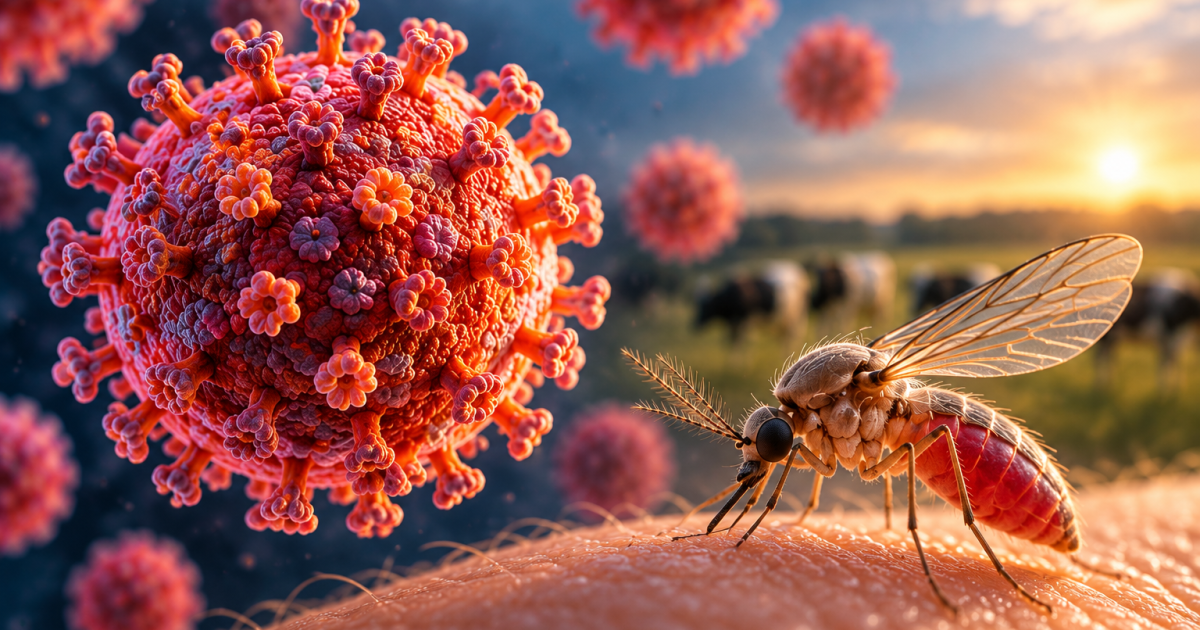
Today, Thursday, October 22, 2026, the French health authorities announced the recording of the first documented human infection in the world with the “Shamonda” virus, which until now was thought to only infect animals, in a patient who died earlier this month while receiving treatment in a hospital in the city of Lyon.
The French Ministries of Health and Agriculture said, in a joint statement, that the patient was suffering from a severe immune deficiency, and was receiving treatment for a serious illness in Lyon civilian hospitals, noting that preliminary investigations suggest that brain complications that appeared before his death were linked to the viral infection.
However, the authorities have not yet decided whether the virus was the direct cause of death or one of the factors that contributed to it, stressing that medical, laboratory and epidemiological investigations are continuing to determine the nature of the infection and the circumstances of its transmission to humans.
The French authorities described the case as “exceptional”, given the severe weakness of the patient’s immune system, stressing that no health risk to the general population has yet been detected, based on the available scientific information.
How was the virus transmitted to the patient?
The authorities suggested that the patient had acquired the infection as a result of the bite of a small insect of the genus Culicoides, known as the stinging finch, in the eastern region of France, where the spread of the virus among animals was recorded during the past spring and summer.
These insects are the main transmitter of the virus among animals, especially cows, but they are not traditional mosquitoes, as they belong to a different group of biting insects.
The exact path through which the infection was transmitted to the patient has not yet been proven, and the authorities have not announced the existence of other cases among humans or evidence of transmission of the virus from one person to another.
The French government confirmed that it had notified the World Health Organization and the European Center for Disease Prevention and Control of this development, within the framework of international cooperation to monitor emerging diseases.
What is Chamunda virus?
The Chamunda virus belongs to the “Orthobunyavirus” genus, which is a group of viruses that includes species that infect animals and others that can infect humans.
The virus was first discovered in Nigeria during the mid-1960s, and then was detected sporadically among cows in regions of West, East and South Africa, as well as in Japan.
Although nearly 6 decades have passed since its discovery, no human infection with the virus has been documented, and therefore it was believed that it was unable to transmit to humans.
In the summer of 2026, the virus was detected for the first time on European farms, including France, Germany, and Switzerland, before its spread among animals expanded in other European countries.
According to the French National Institute for Research in Agriculture, Food and Environment, the infected cows showed symptoms that included fever, diarrhea, lethargy, and decreased milk production.
The researchers indicated that the infection may be more serious in pregnant cows, given the possibility of causing miscarriage or the birth of calves suffering from congenital deformities.
A scientific study published in the journal Eurosurveillance on August 20, 2026 documented the emergence of a Chamonda-type virus in herds of French cows, but there was no evidence at the time that it could infect humans.
Europe is monitoring developments
Meanwhile, the European Center for Disease Prevention and Control (ECDC) announced that it is following the case in coordination with the French authorities and European partners, with the aim of assessing the repercussions of the discovery of the first human infection with the virus.
The center explained that the virus was detected in recent months among farm animals in a number of European countries, including France, Germany, Spain, Italy, Belgium, the Netherlands, Austria, Portugal, and Switzerland.
He added that investigations are still underway to determine whether the infection caused or contributed to the patient’s death, in addition to determining how the virus was transmitted to him.
The center works in cooperation with a European reference laboratory to enhance examination and diagnostic capabilities, to help member states detect any possible human infections.
Does the virus pose a danger to humans?
Despite the importance of discovering the first human infection, the French authorities stressed that the available data does not currently indicate a health threat to the general population.
This is partly due to the exceptional nature of the case, as the patient had a severely weakened immune system, which made him more susceptible to infection and its complications compared to healthy people.
The French Ministry of Agriculture also confirmed that there is no scientific evidence that the virus is transmitted to humans through the consumption of meat or milk and its derivatives.
The discovery of the first infection remains an important development in understanding the ability of some animal viruses to infect humans, but it does not necessarily mean that the virus has become able to spread widely among them.
The French authorities are continuing their investigations according to the “One Health” approach, which brings together medical, veterinary and environmental expertise, with the aim of understanding how the infection is transmitted and assessing potential risks.
Pending the results of these investigations, the most prominent scientific question remains whether the patient’s infection was a rare condition associated with a weak immune system, or whether it reveals a previously unknown ability of the virus to infect humans.