

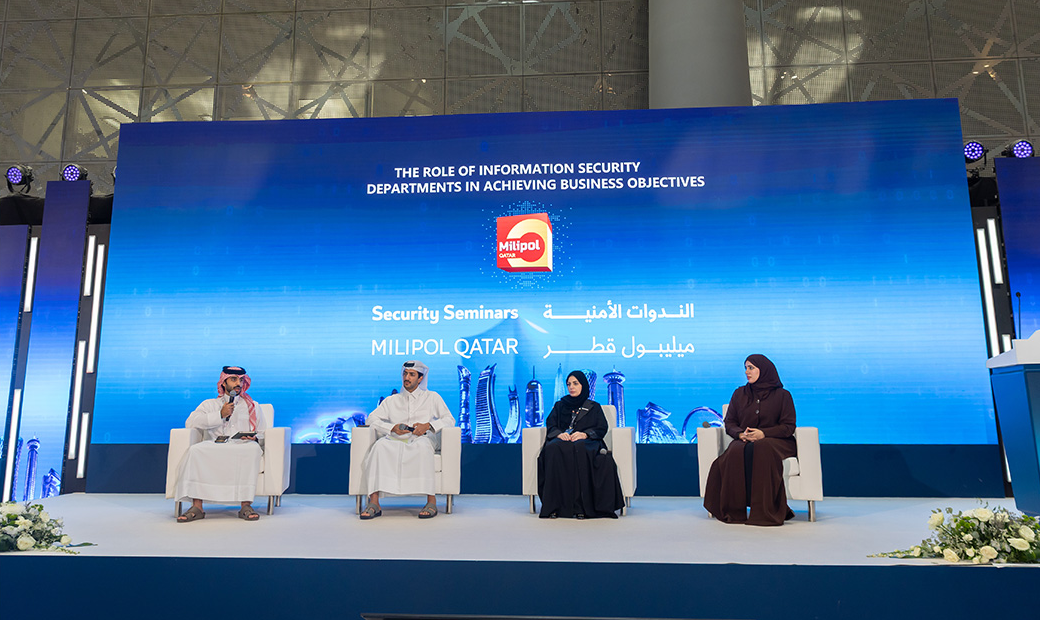
Participants in a security symposium entitled “Cybersecurity and Digital Transformation in National Security”, within the activities of the third and final day of the Milipol Qatar 2026 Exhibition and Conference, called for enhancing integration between cybersecurity and institutional operations, and developing risk management mechanisms and responding to digital threats, to ensure the continuity of vital services.
In this context, Sarah Al-Mawlawi, Director of Information Security Department at Arid Qatar, stressed the importance of going beyond the traditional role of cybersecurity based on governance and risk management, towards enabling businesses and integrating protection requirements into business and technical processes.
Al-Mawlawi explained that achieving this integration requires strengthening cooperation between cybersecurity teams and relevant departments, while maintaining the independence of risk assessment, clearly defining responsibilities, and raising risks to senior management to take appropriate decisions regarding treating them or accepting them according to business requirements.
For his part, Khaled Al-Nasr, Assistant Director of the Information Security Department at the National Cybersecurity Agency, stressed the importance of the independence of information security departments in enhancing proactive risk management, and clarifying responsibilities and escalation procedures, which contributes to reducing confusion during crises.
Al-Nasr pointed out the need to integrate cybersecurity into business continuity, disaster recovery, and crisis management plans, pointing out that dealing with cyberattacks, especially those targeting government agencies, should not be limited to restoring information technology infrastructure, but rather include ensuring the continuation of vital government services or their restoration within acceptable time frames.
In turn, Dr. Maryam Ahmed Al-Faihani, Director of the Cybersecurity Department at Qatar Central Bank, stressed that cybersecurity is a shared responsibility that requires establishing an institutional culture aware of digital risks, and aligning protection initiatives with the institutions’ strategic goals.
Al-Faihani stressed the importance of implementing effective awareness programs and encouraging communication and cooperation between cybersecurity specialists and other departments, in a way that enhances the flexibility of institutions and the continuity of their business, especially in the financial sector.