

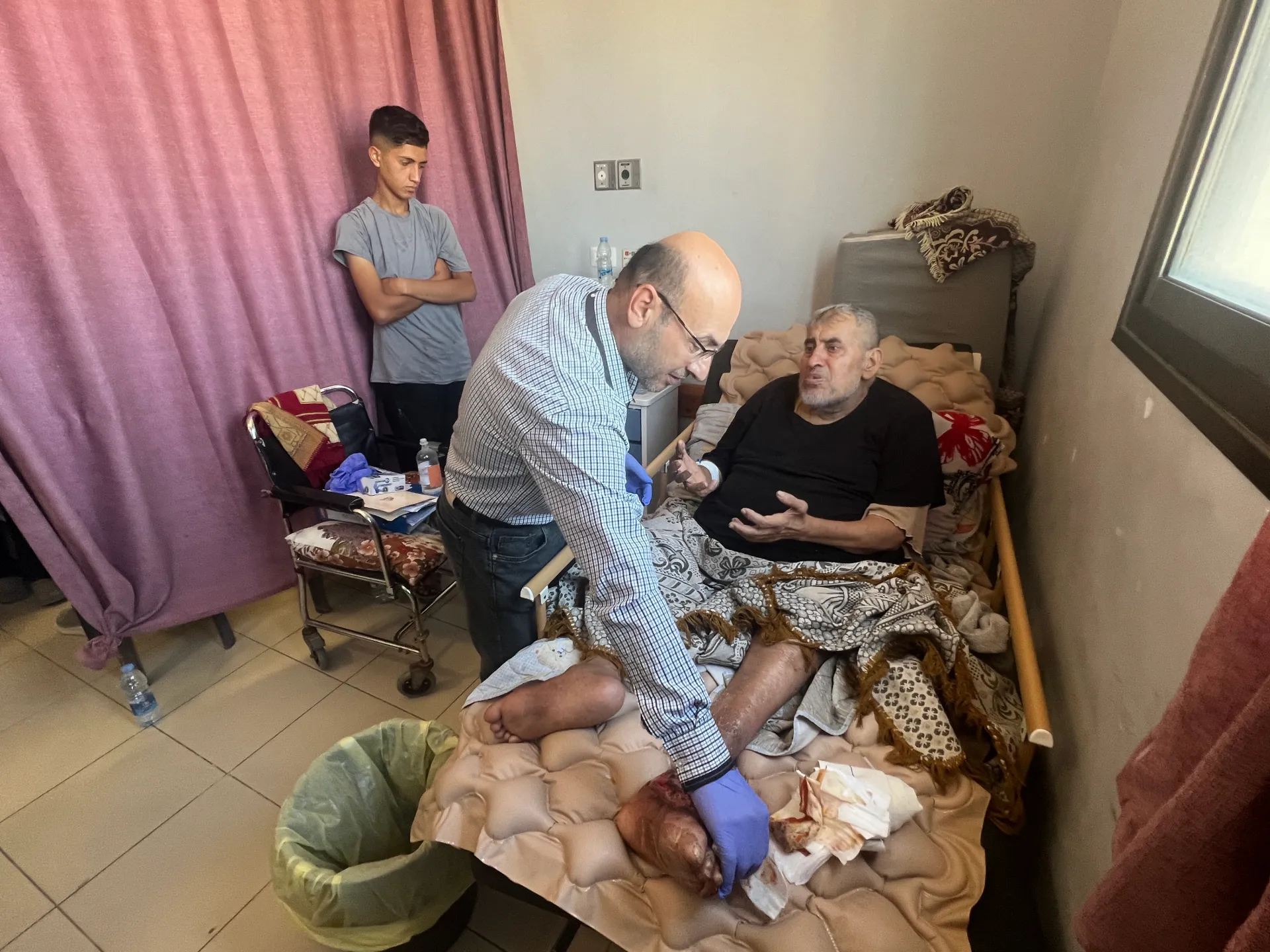
Gaza- The memory of Dr. Bassam Al-Masry, head of the Department of Plastic Surgery and Burns at Al-Shifa Medical Complex, is still burdened with details of the days of the genocide war, when the arrival of hundreds of wounded people to hospitals in successive batches presented surgeons with injuries exceeding in size and complexity what they were accustomed to dealing with.
Extensive burns, deep wounds, and limb injuries were reaching emergency departments at a time when hospitals were suffering from a severe shortage of personnel and supplies, while doctors had no choice but to work with what was available to save the largest possible number of injured people.
In these circumstances, plastic and reconstructive surgery, according to Al-Masry, is no longer a specialty limited to improving appearance or treating the effects of injuries after the condition stabilizes. Rather, it has become part of life-saving care, especially in cases of severe burns and limb injuries that leave bones and tendons exposed.
Al-Masry says that in many cases, this type of injury requires early intervention to cover the tissues, protect the bones, and prevent infections and complications that may lead to amputation or death.
However, the ability to perform these operations declined as the war continued, in light of the shortage of specialized doctors, the disruption of hospitals, the scarcity of disinfectants, infection control supplies, antibiotics, and medical consumables, in addition to the difficulty of providing microsurgical tools.
Burn mortality: 3 to 70%
Al-Masri recalls the status of the specialty of plastic and reconstructive surgery in Gaza before the war, saying that the number of doctors working in this field ranged between 8 and 12 doctors, at a time when the Gaza Strip did not have, according to his description, a complete training structure according to the standards that the doctors had hoped for.
With the outbreak of war 3 years ago, roads between the north and south of the Gaza Strip were cut off, and hospitals were out of service, the number of doctors able to work in hospitals in the north shrank to about 3 or 4 doctors, according to Al-Masry.
This small group of plastic and burn surgeons had to deal with large numbers of injured people, at a time when medical needs far exceeded available capacity.
Al-Masry told Al-Jazeera Net that the death rate among those suffering from severe burns (covering between 20 and 30% of their bodies) – which did not exceed about 3% before the war – rose during the war to about 70%.
He added that hundreds of injured people who survived the bombing and initial injuries later died as a result of complications from wounds and infections, and children were among the most vulnerable groups, as some of them arrived at hospitals with severe injuries after losing members of their families.
Al-Masry estimates that between 30 and 50% of injuries during the war required, to varying degrees, intervention from the field of plastic and reconstructive surgery. A large percentage of them were severe burn injuries or injuries to the extremities that led to the exposure of bones and deeper tissues.
He explains that leaving these injuries without early coverage and repair increases the risk of infection and bone damage, and may make amputation necessary or increase the risk of death.
He says intervention within the first hours, and in some cases within the first 48 hours, can be crucial in preventing these complications.
But this was not always available, according to Al-Masry. In addition to the shortage of specialized doctors, he mentioned other factors that affected the patients’ chances of survival, including malnutrition, limited infection control procedures, a shortage of psychiatrists, and a scarcity of antibiotics and basic consumables, including gauze and disinfectants.
The lack of resources was not the only thing putting pressure on the sector. According to Al-Masry, health workers were subjected to arrest and harsh detention conditions, while a number of doctors specializing in plastic and reconstructive surgery were killed, including doctors Muhammad Al-Maqadma and Medhat Saidam.
With the loss of these and others, the gap between the extent of the need for the specialty and the number of doctors capable of providing it widened.
Al-Masry arrested
Al-Masry was not spared arrest and torture. He tells Al Jazeera Net harsh details about his kidnapping period, which began in March 2024 while he was at work, inside the Al-Shifa Medical Complex, where he found himself detained in extremely harsh conditions that lasted 47 days.
During his arrest, he and his colleagues were subjected to types of ill-treatment and abuse. They were forced to be blindfolded and handcuffed throughout the period of detention, even in the simplest details of daily life, such as eating or going to the bathroom.
He was also deprived of sleep and terrorized by releasing dogs at night and using stun grenades in a cruel journey of torment and suffering.
Service restoration
With periods of calm and relatively improved conditions, doctors began working to restart some services that had been stopped during the war.
Al-Masry says that one of the priorities is to restore delicate operations for children, including cleft palate and cleft lip surgeries, which were stopped during the long periods of war.
In Al-Shifa Complex, efforts began to rehabilitate these services, coinciding with preparations to reopen and restore the burns department, which before the war was one of the main units in this field in Palestine, and was destroyed by the occupation army during the war.
But restarting departments does not mean solving the problem of staff shortages, as the war led to the loss of doctors and the departure of others, while building new specialists requires years of training.
From here emerged the idea of creating a new training track for plastic and reconstructive surgery dedicated to the conditions imposed by conflicts.
The project is based on training doctors from existing surgical specialties, and linking them with Palestinian, Arab and international expertise outside the Gaza Strip, instead of relying exclusively on the presence of trainers permanently residing inside Gaza.
A project started in Britain
Thousands of miles away from Gaza, Palestinian doctor Ahmed Mufid Al-Makhalati (former head of the plastic surgery department at Al-Shifa Hospital in Gaza), a surgeon currently based in Britain, began working on formulating a model to deal with the growing shortage of plastic and reconstructive surgeons within the Strip.
The idea came in light of the difficulty of Palestinian surgeons residing abroad arriving in Gaza, and the shortage that struck local staff after the martyrdom of a number of specialists and the departure of others from service.
Al-Makhalati believes – in an exclusive interview with Al Jazeera Net – that the traditional training model, which requires the presence of permanent resident trainers, has become very difficult in the conditions of Gaza.
Therefore, the project turned to a hybrid model that combines clinical training within the sector, distance education, and the use of external expertise.
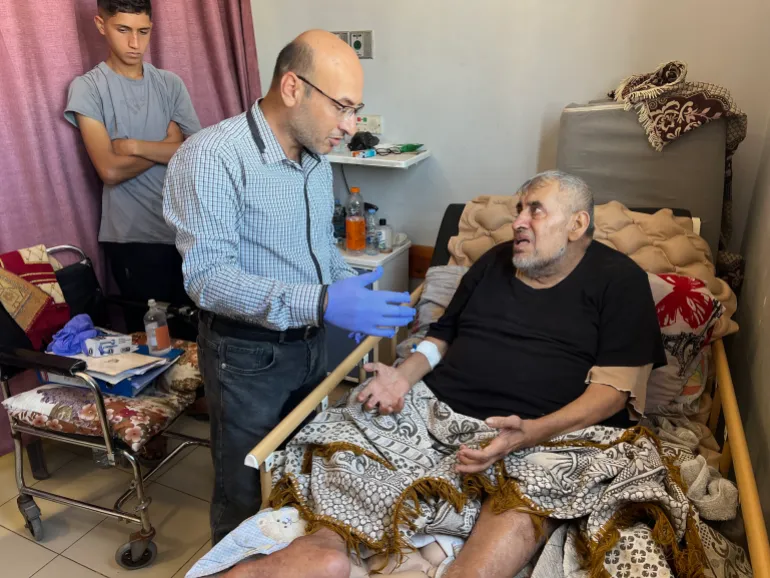
The model includes organizing regular visits for about 20 international and Arab experts, in addition to consultations, electronic training, and direct support for doctors working at the Shifa Complex.
Among the participating names, according to those in charge of the project, are Dr. Ghassan Abu Sitta, Dr. Victoria Rose from London, and Dr. Hamad Al-Jaber from Qatar.
The idea, as Al-Makhalati explains, is not to compensate for the shortage with temporary foreign staff, but rather to transfer knowledge and experience to local doctors who can continue working after the end of the medical visits.
Fellowship in Plastic and Reconstructive Surgery
After the program matured, the Ministry of Health in Gaza announced the start of registration for the “Fellowshipment in Plastic and Reconstructive Surgery in Conflict Areas” program, with the aim of preparing surgeons capable of dealing with complex injuries caused by wars.
According to Al-Makhalati, the program is supported by and in cooperation with the Conflict Medicine Program at the American University of Beirut, while there are efforts to align with the Royal College of Surgeons in Ireland.
In its first phase, the program targets doctors who are board-certified in general surgery or orthopedic surgery, with the number of trainees gradually expanding according to available capabilities.
The plan is based on training lasting 3 years according to a hybrid system that combines practical training and distance education, benefiting from experts from outside the sector.
According to the details of the project, Al-Makhalati says that it targets 7 doctors in its first year, with the possibility of adding 3 or 4 trainees annually in the subsequent stages.
The plan bets that this path will lead, in the long term, to an increase in the number of plastic and reconstructive surgeons in Gaza, instead of relying on medical aid and temporary surgical delegations to address needs that have accumulated during the war.
Between need and obstacles
But the road ahead for the project is still fraught with obstacles that go beyond medical training, according to Dr. Al-Makhalati. Access to Gaza and the movement of doctors and experts depend on complex transit arrangements, while hospitals suffer from a shortage of specialized surgical tools and health institutions face difficulties in financial transfers and purchasing supplies.
Al-Mukhallalati points out that some international institutions are reluctant to deal with projects related to Gaza, which adds another obstacle to the series of restrictions facing rebuilding the specialization.
But Al-Mukhallalati believes that the cooperation of the health authorities in Gaza and their support for the project, along with the enthusiasm of doctors in the Gaza Strip and the eagerness of doctors abroad to offer their expertise, provide important factors for the success of the fellowship program.
He adds that the participating doctors from outside Gaza are doing their best to make the project a success, hoping that the program will contribute over time to building local cadres capable of continuing to provide plastic and reconstructive surgeries within the Gaza Strip.