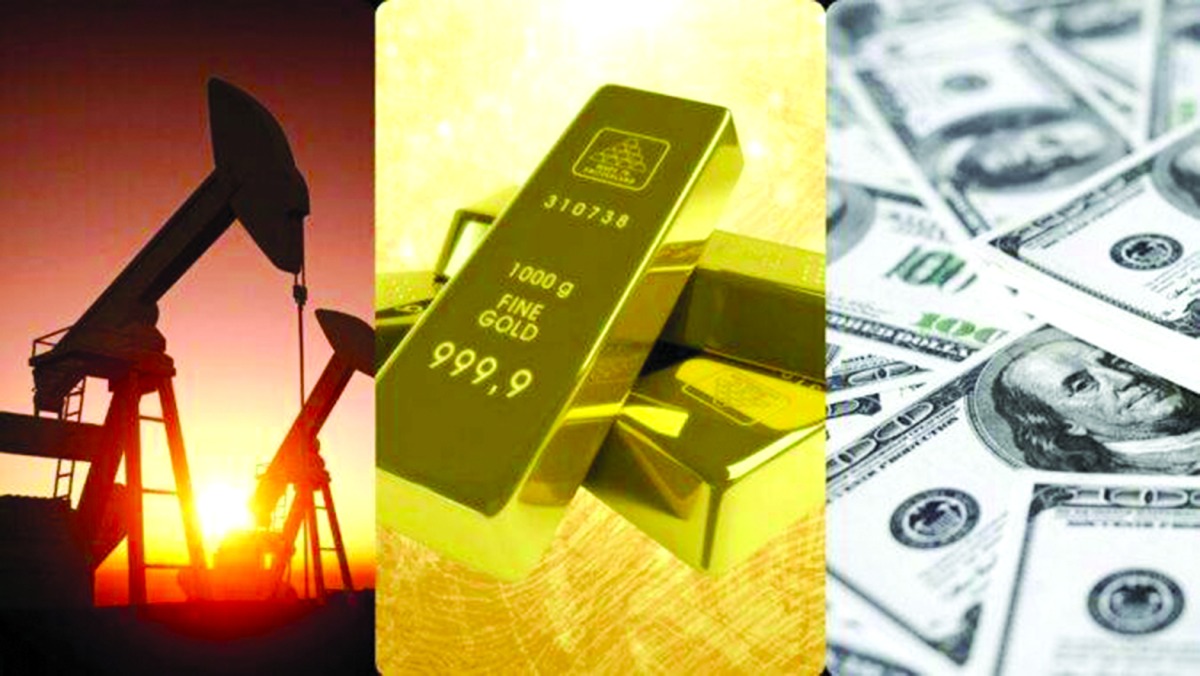
Global markets are currently witnessing great confusion in light of the intensification of geopolitical tensions in the Middle East, where investors are concerned with anxiety towards developments that are not limited to the borders of the affected countries directly, but extend to turmoil in oil and gas prices, and fluctuations in the value of the dollar, and weakens confidence in the global stock exchanges, the oil and gas sector
Oil prices recorded fluctuations after 7% on Friday, and oil prices witnessed severe fluctuations, as Brent crude futures and West Texas intermediaries increased by more than 4 dollars per barrel after mutual military strikes, before retracting some of their gains.
In the latest transactions, Brent crude futures decreased by 21 cents, or 0.28% to $ 74.02 a barrel, while US West Texas Intermediate crude futures fell 14 cents, or 0.18% to $ 72.77.
Gold jump
On the other hand, the Israeli strikes on Iran caused a jump at gold prices by 1.5-1.7% and reached between 3,430-3,446 dollars an ounce, and prices fell with profit traders after their rise to approach their highest levels in two months, and gold decreased in early instant transactions yesterday, by 0.42%, recording 3418.17 dollars an ounce (ounce), after To reach its highest level since April 22 earlier in the session, and US gold futures fell 0.59% to 3432.80 dollars.
According to Reuters, the chief market analyst in the Asia Pacific region of “Uanda”, that what is happening is a rise in the political risk allowance, which enhances the demand for gold as a safe haven. Experts suggest that if an escalation or the US Federal support continues to reduce interest, gold may continue to climb about 3,500-3,700 dollars, and this may exceed the end of the year.
On the other hand, the US dollar has not seen a clear rise as a safe origin as is the case in previous crises, as the DXY index was traded around 97.8 – 98.0, at a low level that has not witnessed the same since mid -2022, this decrease is an indication of the dollar’s loss of some of its attractiveness as a traditional safe origin, in exchange for the escalation of the demand for gold as an alternative option in times of crisis.
Investors also await the decisions of the central banks, including the American Federal Reserve, and other central banks who take cautious positions, adding a state of anticipation to the dollar price.
Despite the state of tension, some financial markets such as Japan showed relative flexibility, as the indicators on the Tokyo Stock Exchange increased with the acquisition of geopolitical tensions in the Middle East on the attention of investors, amid optimism that the conflict can be contained with the intervention of major countries.