

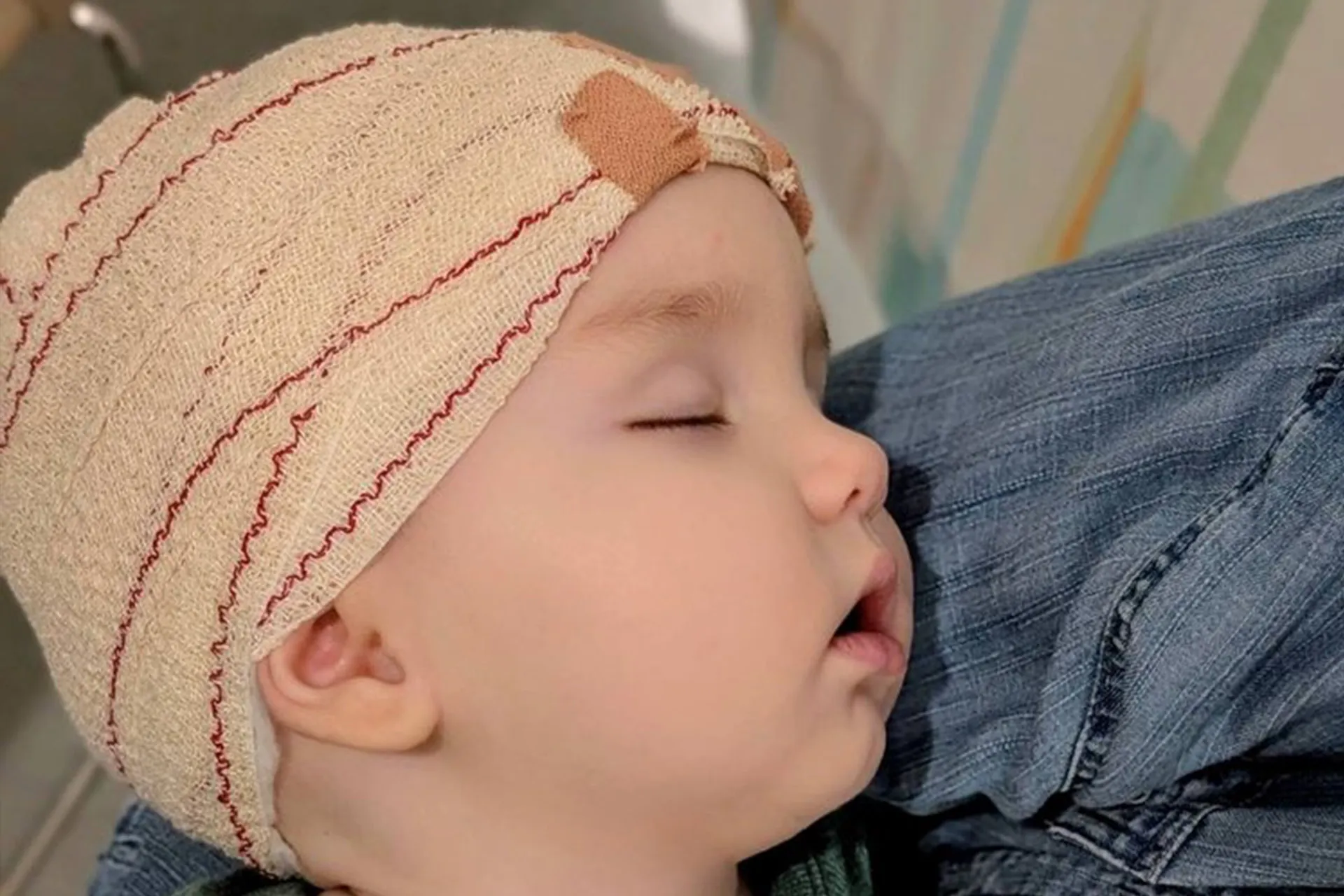
Rory Potter’s head was larger than usual since his early days, which caused concern for his parents after his birth in April 2025. After examinations, it was found that the British child had a severe case of premature fusion of the bones of the skull, but his treatment this time set a global medical precedent.
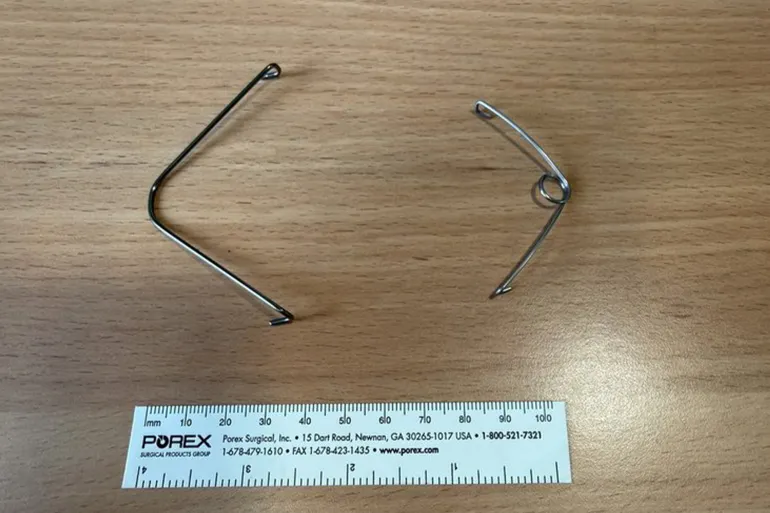
When Rory was about 5 months old, he underwent surgery at Great Ormond Street Children’s Hospital in London in which, for the first time in the world, springs made of a metal with the property of “ultra elasticity” were used in order to gradually reshape his skull.
More than a million pounds has been spent on researching this technology. Great Ormond Street Hospital announced the details of the operation on September 8, 2026.
A problem that began at birth
Rory, who is from Derbyshire, was diagnosed with sagittal craniosynostosis, a condition in which one of the joints of the skull’s bones fuse prematurely.
This causes the skull to grow in an abnormal direction, appearing longer from front to back and narrower at the sides. In severe cases, this problem may limit the space available for brain growth.
Great Hospital points out that the treatment known as spring-assisted cranioplasty has been based on stainless steel springs for about 20 years. The springs are placed after making incisions in the bones of the skull, and then gradually push the bones outward, which helps in the formation of new bone and increases the space inside the skull.
But this method does not give the optimal result in some severe cases, because doctors do not have the same degree of control over the force that the springs apply to the skull, and the child may then need an additional operation, according to the hospital.

Spring designed for one child
Here came the new idea. Instead of using traditional steel springs, a team of Great Hospital surgeons and UCL engineers developed nitinol springs and designed them to adapt more closely to the growing baby’s skull.
Doctors do not place a ready-made spring in the skull, but rather design it for each child individually. The team starts with CT scans of the skull, then builds a 3D digital model that simulates its response to the operation.
Modeling then determines how much force is required and where to apply it, before manufacturing springs appropriate to the situation. The hospital says the modeling process takes about one day.
The surgical procedure itself takes less than an hour, according to the hospital, compared to the time of previous operations, which was longer. After the springs are installed, they remain in place for weeks or months, while gradually pushing the skull bones into the desired shape.
45 minutes changed the shape of the skull
For Rory, it took about 45 minutes to install the springs in September 2025. The child did not need a long hospital stay, as he stayed one night for observation, then returned home while the springs gradually continued to work.
After 9 weeks, Rory returned to the hospital to remove the springs after his skull reached the desired shape, according to Great Hospital.
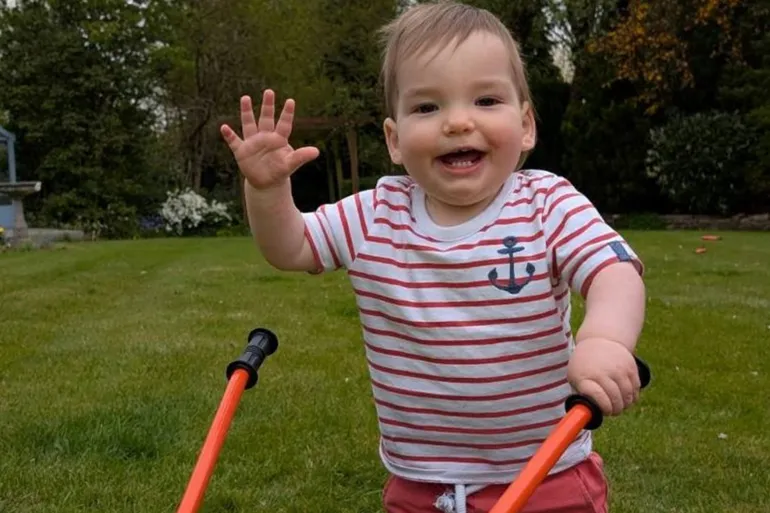
Nearly a year after this unique medical experience, the hospital says that Rory is living his life normally, playing with his older brother and the family dog. His mother, Jo Potter, said that her son had become “happy and full of energy” and that whoever sees him today may not know what he went through.
This is not the first time for springs…so what’s new?
Although the medical experiment was described as a “world precedent,” the idea of using springs to reshape the skull itself is not new.
Steel springs have been used in this type of operation for about two decades, and it is a technology developed by Great Hospital in cooperation with University College London. What is new is the use of ultra-elastic Nitinol springs designed based on computer modeling for each child.
Professor Awas Jilani, a neurosurgeon at the hospital and one of those involved in developing the technology, says that traditional steel springs are durable, but they do not always allow the force acting on the skull to be adjusted accurately enough, while nitinol springs give the team greater flexibility, and may help in some cases to avoid the need for an additional operation.
A promising technique, but it has not become a routine treatment
Despite the positive result achieved by the medical experiment with Rory, the new technology is still in its infancy. Great Hospital explains that the use of Nitinol springs currently requires individual approval from the British Medicines and Medical Devices Regulatory Authority (MHRA) for each patient, because the technology is new, while the team is working on examining the possibility of making it available to a larger number of children.
The development of this technology was the result of years of collaboration between surgeons and engineers, led by neurosurgeon Awas Jilani from Great Hospital, Professor Silvia Schifano and the biomedical engineering team at University College London.
Thus, Rory’s story was not just an operation to modify the shape of the skull, but rather the first clinical test of a technique that attempts to make surgery more precise and personalized, as the force that will be applied to the skull is tailored to the characteristics of each child, rather than relying on a one-size-fits-all spring.