

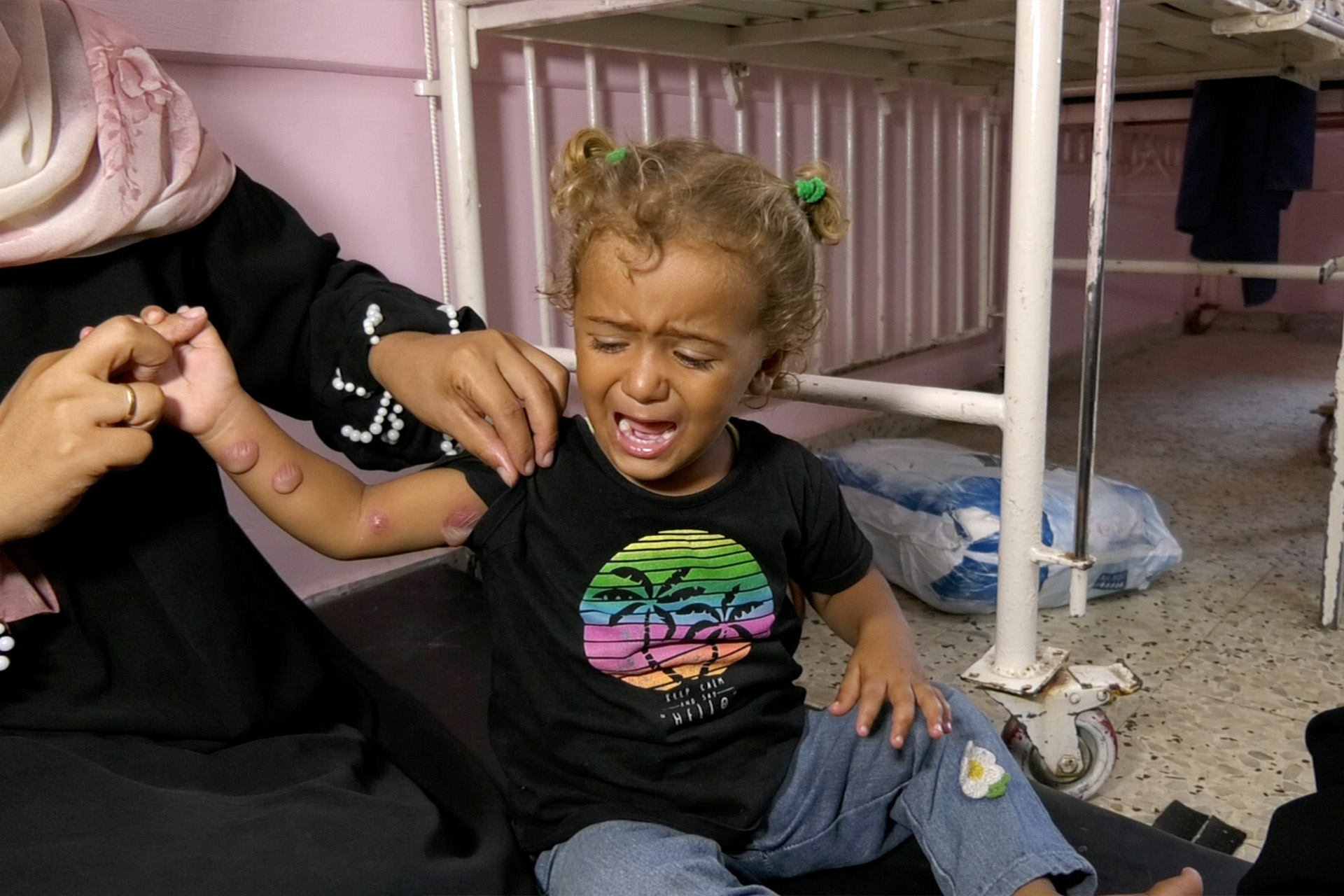
Gaza- Amira Salem, the five -year -old girl, was lying on a bed without a bed in a shelter in the Gaza Strip. Her small body is covered with pimples and infections, and her slender face is shown with pain that is not tolerated by an innocent spirit in her age.
Her mother sits next to her, watching her with two eyes, and she hesitates with an intermittent voice.
Life in tents is unforgiving, and high temperature increases the suffering of the displaced. While the mother tries to cool her daughter’s body with a damp cloth, pimples are doubled day after day, to turn into ulcers that have no medicine.
Doctors say that the condition needs an anti -vital and a special skin oach, but the mother collided with the reality of the void of pharmacies from it, in light of the continued closure of the occupation of the crossings, and the continued siege that suffocates everything and leads even the right to treatment.
At night, the child cannot sleep from the severity of itching. The heartburn is ravaged until her sores flooded blood, while her mother tries to prevent her from itching in vain. “All I want is a drug, only a drug … my daughter collapses in front of my eyes,” she says to Al -Jazeera Net.
According to Al -Jazeera Net, the spread of bacterial rash infections in the Gaza Strip is not just separate individual cases, but rather a epidemic phenomenon that threatens the lives of the displaced, especially children who live in extremely cruel conditions.
Local health organizations are documenting hundreds of new cases daily, while doctors indicate that the absence of medicines and the lack of medical supplies has seriously exacerbated the crisis.
A group disaster
Mohamed Nasser, a young man in his twenties, was injured, weeks ago, with burning pimples that spread on his hands and feet after a long days of overnight with his family in a tight tent near the beach of the Khan Yunis. He tried to ignore the pain at the beginning, but he soon found himself unable to move.
Nasser reminds Al -Jazeera Net, that the matter began with a slight redness in the skin, he thought of heat or sleep on the ground, but the redness soon turned into blisters full of pus, and he could not hold something with his hands.
Nasser was transferred to Al -Aqsa Martyrs Hospital in Deir Al -Balah, where doctors were forced to open and clean pimples. But the pain did not stop at that.
“Every day the situation gets worse. Doctors say there are no medications, just cleaning wounds and trying to control inflammation. I am afraid that the infection will reach the blood.”
As for the child, Raed Abdel -Aali (4 years), his arm was filled with large and burning blisters. His father sits next to him in the hospital tries to calm him while screaming from pain whenever doctors tried to clean his wounds.
The father says that his son has lost the ability to sleep a few days ago, as every body burns itching, and pimples explode one by one. His father carried him to all pharmacies, as he said, but he found no ointment or antibiotic.
He continues during his talk to Al -Jazeera Net, that the doctor told him that the condition may worsen and reach a failure in the body’s functions if the necessary treatment is not available. “But where do I come from? The crossings are closed, and the medicine does not exist,” he added.
The situation is exacerbated
The Palestinian pharmacist, Zulfiqar Sergo, owns a private pharmacy in Gaza City, and describes the scene bitterly, “The cases begin with skin irritation and redness in multiple areas of the body, especially below the neck and under the armpit. Then it spreads to the face and other parts, and the skin becomes rough and appears with painful pus.”
During his talk to Al -Jazeera Net, he adds that these symptoms are exacerbated with high temperatures, humidity, living in tents and the absence of clean water. He explained that children are the most vulnerable, because they cannot take care of themselves.
Dozens of cases of rashes are flocking daily to the Zulfikar Pharmacy, hoping to obtain the medicine, but it is unable to help them. He says it is very dangerous, and it may lead to blood deaths or poisoning due to the absence of treatment, and do not have anything to provide to citizens.
Zulfikar explains that the health system is completely impotent, and more than 90% of the drugs have disappeared from pharmacies, especially antibiotics and skin ointments. The health centers are almost empty, and private pharmacies do not find what they provide.
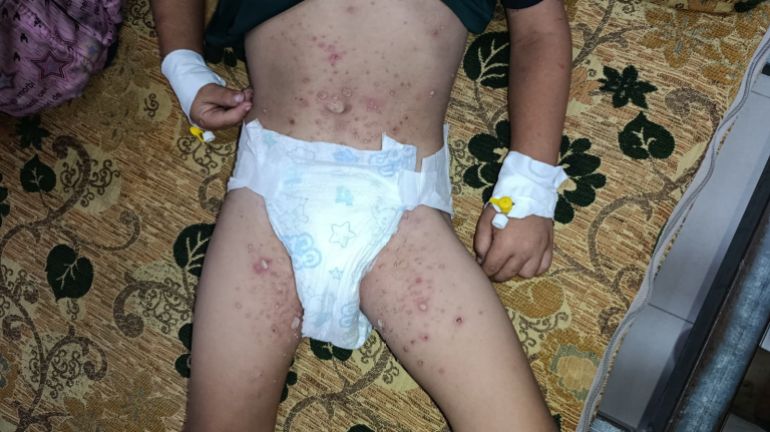
As for the Director General of Hospitals of the Ministry of Health in Gaza, Dr. Muhammad Zaqout, he draws a more detailed picture of the size of the disaster. He says that bacterial rash infections have become very common among the displaced, especially children and even adults, and half cases that reach primary care centers daily linked to these infections.
He adds, in a statement to Al -Jazeera Net, that out of 400 to 500 cases per day that reaches each center, about 200 cases of which suffer from rashes and infections, considering that the number is shocking and reflects the size of the disaster.
He explains that the reasons are intense congestion in the camps, lack of clean water, the high temperatures, and the absence of hygiene tools, then it gets worse due to malnutrition and weakness Immunity in children and adults, which reduces the chances of healing.
SEA
But the absence of medicines is what makes doctors in the face of impossible. “The necessary ointments or topical antibiotics are available,” Zaqout says.
He confirms that skin infections are a risk to the workers and that cases of intensive care have been detected, and even deaths due to blood poisoning and the failure of the body’s functions, as a result of the exacerbation of these infections in patients with malnutrition and poor immunity.
According to Zaqout, the hospitals themselves are no longer able to absorb, and the patients are forced to overnight on a brushes that they bring from their tents. Some of them receive treatment in the corridors or squares, due to the family’s fullness.
He continued, “We asked international institutions to establish new field hospitals, and to pressure the occupation to enter medicines and medical supplies. But so far there is no response, and the situation is getting worse day by day.”
The doctor concludes with a call to the world saying, “We are facing a healthy extermination. All we demand is our right to treatment, the simple right guaranteed by international and humanitarian law. The world should move immediately before this crisis turns into a silent massacre against our people in Gaza.”