

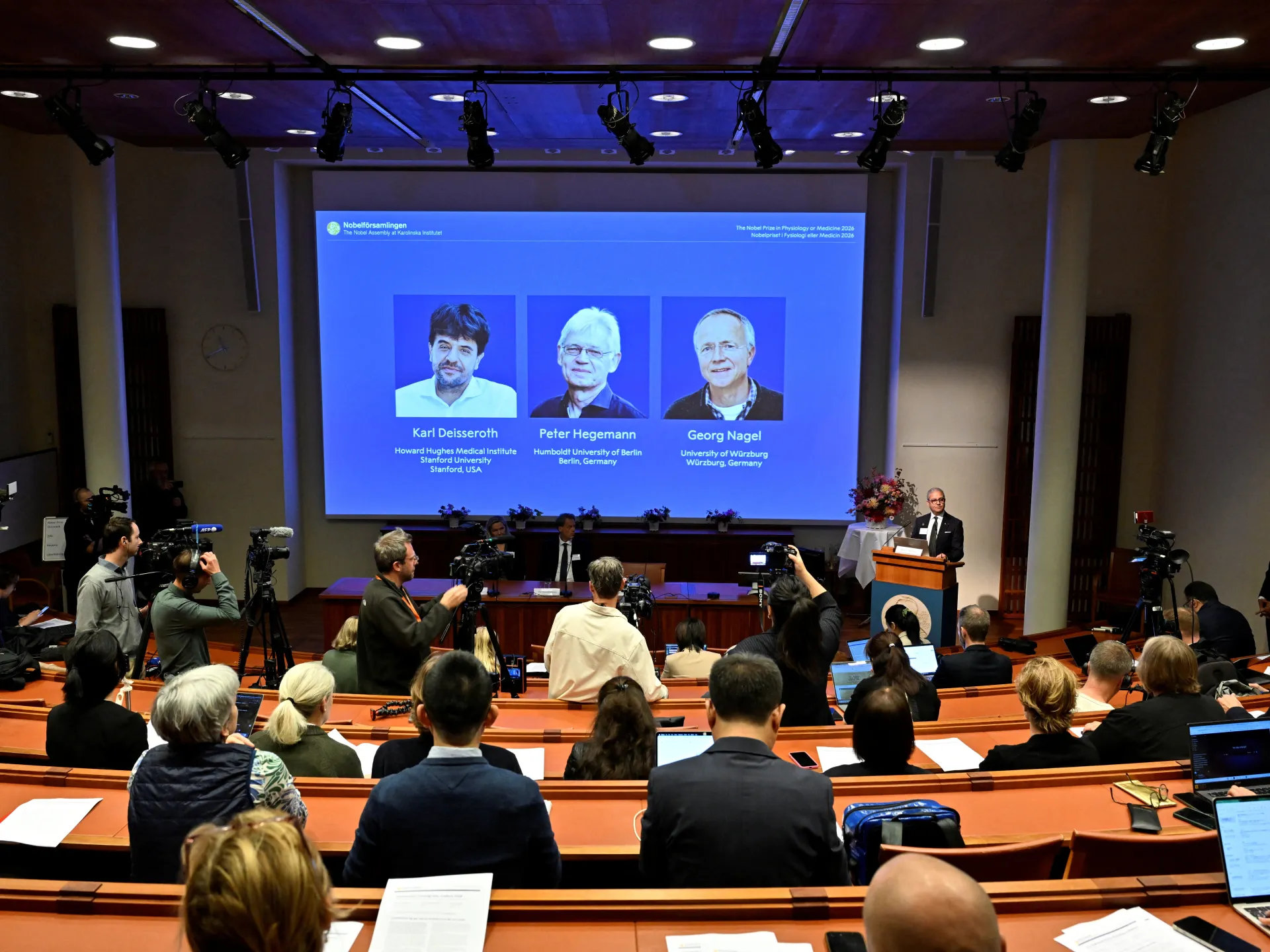
This morning, Monday, October 5, the names of the winners of the Nobel Prize in Physiology or Medicine for the year 2026 were announced. The Nobel Assembly at the Karolinska Institutet decided to award the prize to Karl Deisseroth, Peter Hegemann and Georg Nagel for their discoveries related to ion channels opened by light and optogenetics, discoveries that paved the way for the development of technology that allows controlling the activity of neurons using light.
Scientists who will win the Nobel Prize 2026
-
Karl Deisseroth
Carl Deisseroth works at Stanford University in California as a professor of bioengineering, psychiatry, and behavioral sciences. He is also a researcher at the Howard Hughes Institute. He earned a bachelor’s degree in biochemical sciences from Harvard University in 1992, and continued his education to obtain a doctorate in neuroscience from Stanford University in 1998.
Professor Karl Deisseroth has won dozens of international awards and honors in recognition of his efforts and discoveries in developing optogenetics, between 2002 and 2025, from prestigious scientific institutions and destinations.
In recognition of his efforts in establishing and developing the science of optogenetics and specifically related matters, Deisseroth received several awards and honors, most notably the Breakthrough Prize in Life Sciences, the Kyoto Prize from Japan in 2018, the Lasker Prize for Life Sciences in 2021, the Louisa Gross Horowitz Prize awarded by Columbia University in 2022, and the Japan Prize in Life Sciences in 2023, the most recent of which was the Asan Prize for Basic Sciences. From South Korea in 2025.
Professor Deisseroth’s journey began in 2005 when he and his colleagues were able to genetically modify neurons taken from rats by inserting a light-sensitive gene isolated from pond algae, to show that flashes of blue light were able to stimulate neurons and respond to them at their normal speed of a few milliseconds.
Then, two years later, he was able to activate the light control switch he had discovered in neurons in the brains of living rats. The importance of this discovery lies in the precise stimulation of a single protein within a time range that corresponds to the function of neurons, which enabled him to outperform other existing technologies.
Since then, Deisseroth has continued his research until it recently reached its culmination, and the Nobel Committee indicated that Deisseroth deserved the Nobel Prize for his efforts in turning a protein into a master switch that controls neurons through light.
-
Peter Hegman
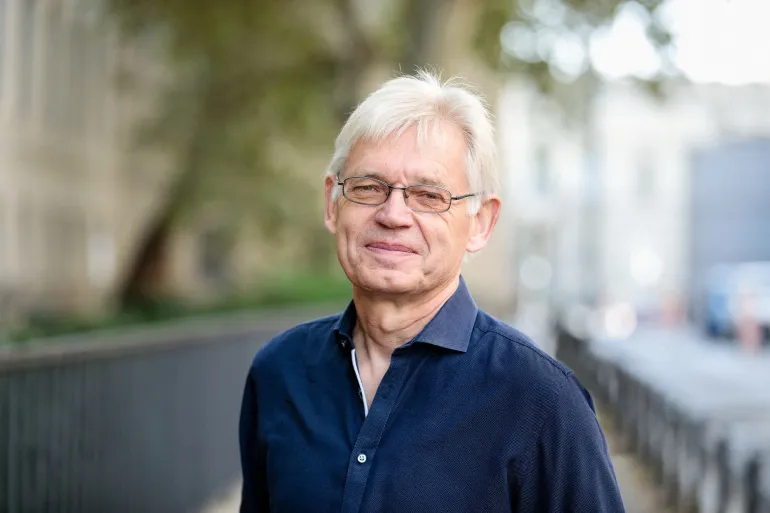
As for Peter Hegemann, he earned a bachelor’s degree in chemistry in 1975 at the University of Münster, then a doctorate in chemistry from Ludwig Maximilian University in Germany in 1994. He currently works as a Hertie senior professor (an honorary academic rank given to a faculty member after his retirement from continuous academic work) in neuroscience at Humboldt University in Berlin, and head of the research group for experimental biophysics.
Hagemann is described as one of the founding fathers of optogenetics, and his research with George Nagel on photoreceptors in a type of unicellular algae called the mycelium led to the discovery of light-sensitive ion channels inside cells; The identification of the relevant protein, Channelrhodopsin 2, enabled precise control of genetically modified nerve cells after exposing them to flashes of light, which opened the door to new hope for the possibility of treating neurological diseases.
He received several prestigious awards in recognition of his achievements in optogenetics, most notably the Louisa Gross Horowitz Prize from Columbia University in 2022, the Lasker Prize for Basic Science Research from the United States of America in 2021, the Shaw Prize in 2020 from Hong Kong in China, the Romford Prize from the American Academy of Arts and Sciences in the United States in 2018, and he received the Mandel Medal from the German National Academy of Sciences Leopoldina in 2017 in recognition of his contributions. in optogenetics.
-
George Nagel
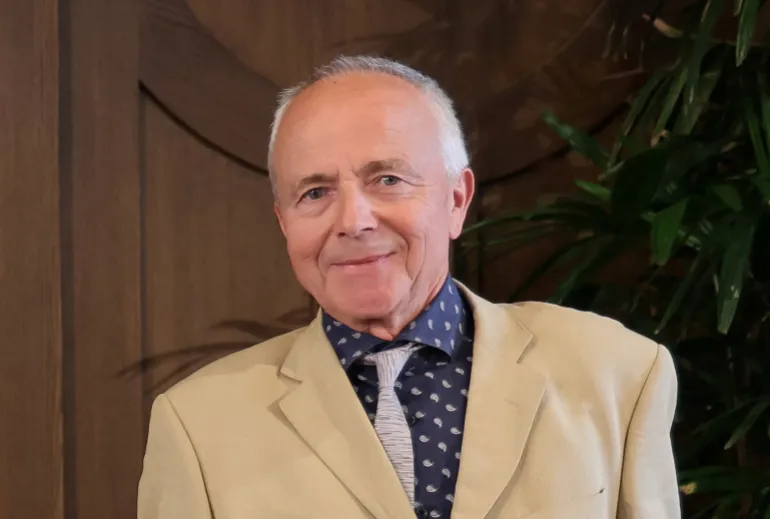
As for the third scientist who won the Nobel Prize in Medicine, along with his two colleagues, he was Georg Nagel, who was born in 1953 in Weingarten, Germany. He studied biology and biophysics at the University of Constance in Germany, then obtained his doctorate in 1988 from the University of Frankfurt, and currently works as a professor at the University of Würzburg in the Department of Neurosciences.
Professor Nagel has received multiple awards in honor of his achievements in the field of optogenetics. He won the Karl-Heinz Bekurts Prize in 2010 in Germany, then the Wiley Prize for Biomedical Sciences in 2010 also in the United States for his role in the discovery of Rhodopsone ion channels. He also won the Romford Prize from the American Academy of Arts and Sciences in Cambridge in the United States in 2019 in recognition of his achievements, and recently the University of Würzburg, where he works, awarded him the Roentgen Medal. Sciences in honor of his scientific achievements.
In the early 2000s, Peter Hegemann and George Nagel were able to discover the protein “channelrhodopsin” on the cell surfaces of the chelicerate algae that were swimming toward the light in their environments – which is what drew Peter Hegemann’s attention to it – as they revealed the ability of these proteins to respond to light in any cell in which they are placed. When exposed to flashes of blue light, the ion channels in the protein molecules open and charged ions flow into the cell, creating pulses. Electrical energy that stimulates an action potential so that the cell responds and transmits information through the axon.
The Nobel Committee described the achievement of the three scientists who won the Nobel Prize for Medicine this year as an important transformation that will make it possible to identify how memories, feelings and behaviors are formed within the living brain, which has remained mysterious for many years. With this “optogenetic” technology, it has become possible to identify the specialized locations within the brain responsible for processes that were only a dream for scientists, which will change the way we understand the brain and deepen it in a better way, paving the way for more advanced discoveries that will allow the emergence of more useful discoveries for humanity in the field of diseases and their treatments.