

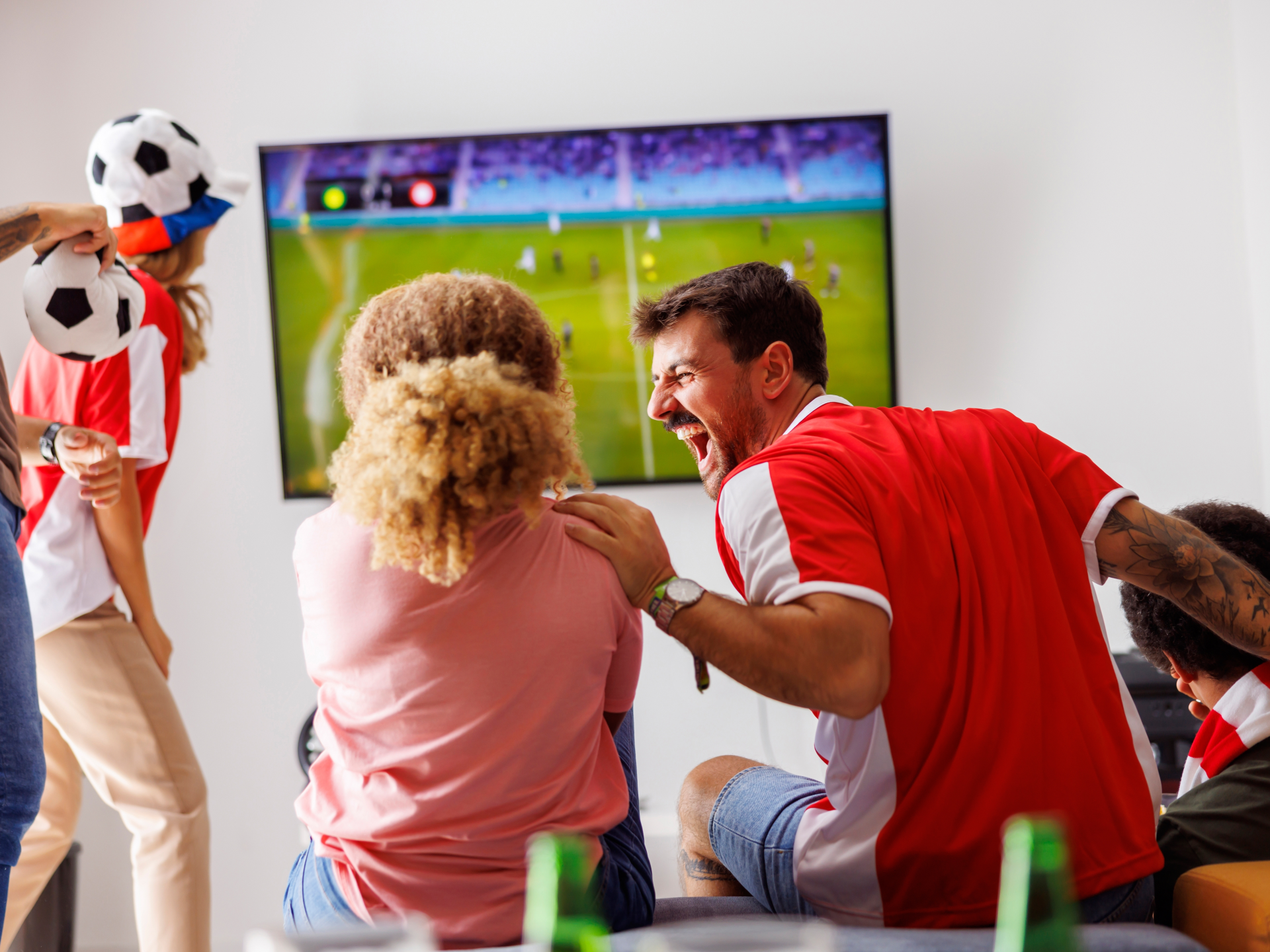
Amid the pressures of work, study, and daily obligations, World Cup matches turn into a time that millions of fans wait for, not only to watch the competition, but also to get a temporary break from thinking about problems and responsibilities, and to share moments of enthusiasm and joy with family and friends.
Studies indicate that watching sports may be linked to improved psychological well-being and activation of areas of the brain associated with reward and pleasure, in addition to enhancing social interaction and a sense of belonging.
But these benefits depend on the way you watch, and the match may turn into a source of tension when the fan identifies strongly with his team or deals with his loss as a personal loss.
When will watching the World Cup become a healthy way to improve your mood? How can we benefit from it without falling into the trap of excessive emotion?
Enjoyment before belonging
Psychological and social researcher and consultant Muhammad Kamal says that watching matches becomes a positive way to improve mood and relieve stress when its primary goal is to enjoy the beauty of the game and performance, away from fanaticism and excessive attachment to the result of a particular team.
He explained that the viewer can enjoy the players’ touches, goals, and good performance, regardless of his affiliation with one of the two teams, pointing out that achieving a degree of neutrality allows him to focus on the beauty of football instead of limiting his experience to winning and losing.
Researchers at Japan’s Waseda University conducted a multi-stage study published in 2024 in the journal Sport Management Review, which included analyzing data from more than 20,000 people, an experiment with watching sports clips, and examining brain activity in a small sample using magnetic resonance imaging.
The results showed that watching sports is linked to improved psychological state and feelings of pleasure, and increased activity in brain areas associated with reward.
These results do not mean that football treats stress or psychological disorders, but they indicate that enjoyable viewing may give a person a mood boost and a temporary break from his preoccupations.

Sports identity
Kamal explained that what is known as “sports identity” makes the fan feel that his team is part of his identity, so he treats his victory as a personal gain, and his loss as if it were his own loss.
To reduce excessive emotion, the psychological and social consultant advises the fan to try to separate his personal identity from his sports affiliation, and to ask himself: What will I actually gain if the team wins? What will I lose if he is defeated?
He noted that achieving this separation is not easy from a practical standpoint, because many fans are psychologically united with their teams to the point where the team becomes an extension of themselves, pointing out that the ability to watch the match with relative neutrality and enjoy good performance requires broader awareness and goals than just winning and losing.
He added that group viewing contributes to strengthening family and social ties, and creates a “shared identity” and a feeling of “we” among fans. This is clearly evident when goals are scored and wins, when family members and friends exchange congratulations and hugs, and these moments may bring them closer even if there are previous differences between them.
A study recently published in the journal Frontiers in Psychology, which included 885 people, showed that watching sporting events was linked to improved psychological well-being, and social interaction and emotional experiences were among the most prominent factors that explained this association.
The researchers found that the effect of social interaction was greater than the effect of the emotions evoked by the match alone, which indicates that an important aspect of the psychological benefit comes from sharing the experience with others.
Impact of big matches
For his part, sports journalist and holder of a diploma in sports psychiatry, Ahmed Saad, said that major matches that are the focus of the world’s attention have a very significant impact on the psychology of the fans, especially when they are played by teams representing their countries. It secretes the hormone oxytocin, which enhances belonging, relationships, and social bonding.
He explained that exciting sports matches and activities create a kind of separation from the pressures of life, as a person temporarily separates from these pressures and focuses on the match. The brain also secretes the hormone dopamine, which is responsible for happiness and a sense of accomplishment, because the spectator feels that he is participating by encouraging him in achieving the achievement that his team is achieving.
He stressed that sports in general, and football in particular, have an important psychological impact, and this impact becomes greater when a person follows a team or national team that represents his country.

What happens after the final whistle?
On the other hand, Saad pointed out that watching matches may have some side effects, as the hormone dopamine is secreted at a very high level during the match, as is the hormone adrenaline, which is responsible for energy, strength, and readiness for emotions and quarrels.
He added that after the match ends, the level of dopamine begins to decrease rapidly, while the effect of adrenaline on the body and brain continues, and therefore a state of what is described as “post-match depression” may sometimes occur, and the fan needs a period for it to go away.
He explained that this situation is more evident when the team that the person supports loses, or when the audience feels that there is arbitration injustice in the match, as this increases the fan’s state of depression and makes the effects of adrenaline not go away easily.
The term “post-match depression” is used here to describe a temporary state of sadness and frustration after a loss, and not as a medical diagnosis of depression.
Studies support the idea that fans who are highly attached to their teams may experience a stronger physical response to stress; A study conducted by Oxford University during the 2014 World Cup found a greater increase in cortisol levels in fans who were more engaged with their team, especially during matches that ended in losses.

Educational opportunity
Social worker Alaa Hussein confirms that following the World Cup can turn for students into an educational space that helps them develop the skills of dialogue, exchange of opinions, and analysis, provided that it takes place within a framework of respect and acceptance of difference.
He explained that among the most prominent benefits of follow-up for school students is learning sportsmanship, respect for competitors, and a balanced response to winning and losing, which are skills that can be reflected in their behavior inside school and in their relationships with their classmates.
Hussein pointed out that directing students to discuss matches in a calm manner contributes to enhancing teamwork and cooperation. It also trains them to accept different inclinations, nationalities, and sporting affiliations, and supports the values of tolerance and positive coexistence.
He added that watching the tournament may represent an entertainment means that reduces the pressures of study if it is organized in a way that does not affect sleep or duties, pointing out that the benefit is not achieved from watching alone, but from the way it is used to build a more balanced personality and the ability to control emotions.
Watching matches is a healthy break when the student determines which matches he wants to watch, completes his homework before they start, and avoids long stays and heated arguments after they end.
Enthusiasm can also be turned into a practical activity, such as playing football or walking with friends, instead of limiting the relationship with sports to sitting in front of the screen.
Therefore, World Cup matches give the fan a mental break from the pressures of life, improve his mood, and bring him closer to others. Its true benefit appears when it remains a space for fun and communication, far from fanaticism or neglect of responsibilities, and when the fan realizes that the result of the match does not represent a personal gain or loss.