

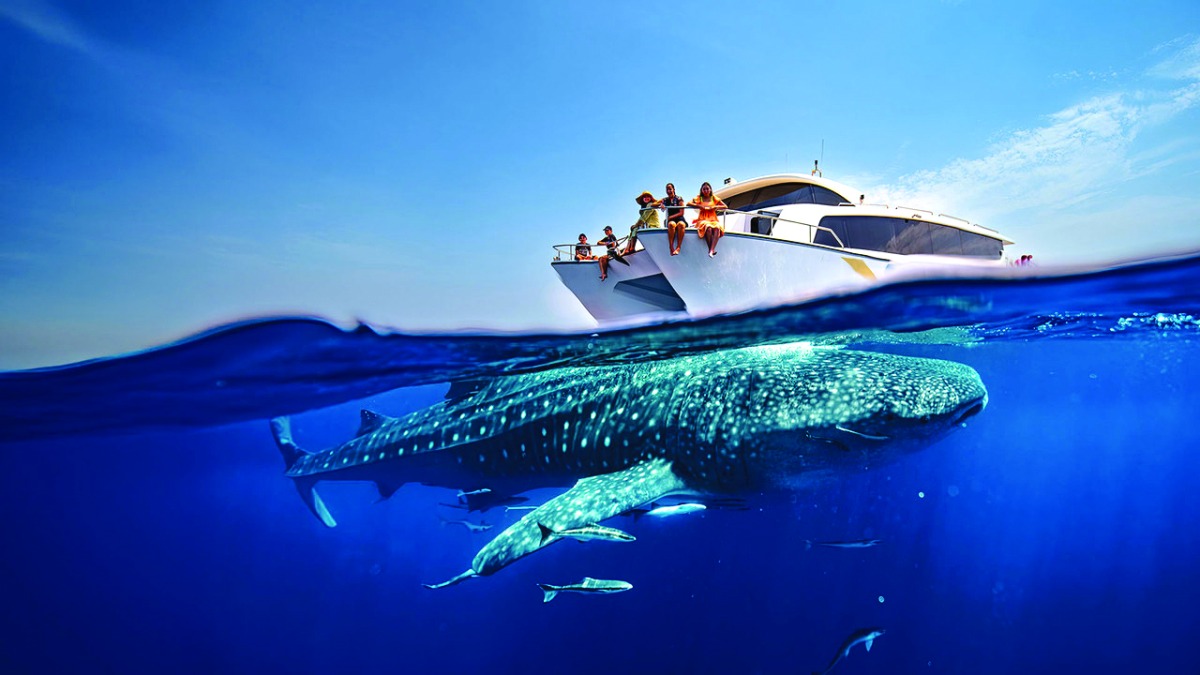
The northern water of the State of Qatar is home to the largest known gathering of whale sharks in the world, and this natural phenomenon is an exceptional opportunity to closely monitor these giant marine organisms in a marine environment rich in biological diversity.
In this context, Qatar Tourism, in cooperation with “Qatar,”, launched the season of “Pisces of Pisces in Qatar” for the year 2025, as one of the most unique natural experiences in the marine environment at the state and the region.
The organization of the “Pisces” tours comes with the aim of enhancing environmental tourism, enabling visitors to enjoy an information -rich experience on the behavior of these majestic organisms, and the leadership of the State of Qatar in protecting endangered marine organisms and preserving the marine environment.
The return of whale sharks in its new solution came as a result of fruitful cooperation between a number of entities in the public and private sectors, including Qatar Energy, the Ministry of Municipal, Qatar Ports, Qatar Airways, the Ministry of Environment, Climate Change and the General Administration of Coast and Border Security, as these partnerships contribute to the effective operational aspect of tours, which raises the level of services and experience provided to visitors.
In this regard, Mr. Omar Abdel -Rahman Al -Jaber, head of the tourism development sector in Qatar for tourism, said, “The return of whale sharks is an important step in our march towards promoting sustainable environmental tourism that reflects the richness of marine life in the State of Qatar.” He pointed out that work is currently working on completing preparations to launch the new season, in cooperation with a number of government agencies and the private sector to ensure the provision of an exceptional experience that is in line with the best environmental standards And tourism, and to develop this distinguished tourism product in the country.
The tours are launched on a luxury boat under the supervision of specialized marine guides, where an integrated educational experience is presented for visitors that include a comprehensive presentation on the patterns of their migration and biological characteristics, and the importance of whale sharks in the marine ecosystem.
The season season extends from June to September, when visitors can explore the whale sharks of up to 20 feet in the Shaheen Marine Field area located approximately two and a half hours from Ruwais Port.
Since its launch in 2022, the rounds have attracted more than 1,200 visitors, while recording views of more than 600 piasters whale per trip.
The State of Qatar is one of the world’s few destinations that provides a specialized program for the protection and study of whale sharks, which reflects its firm commitment to preserving the marine environment and consolidating its position as a leading global destination in sustainable tourism.
Residents and visitors can take advantage of these trips, and temporary passengers (transit) transites from Hamad International Airport also can also participate through reservations through the official website of “Visit QATAR”.
The whale sharks tours represents an exceptional opportunity for travelers whose periods of stopping in Doha have a certain number of hours, as they can use it in fighting an unforgettable marine adventure, redefining the concept of temporary stop and turning it into a unique experience that enriches their journey, instead of being just waiting in the airport halls.
Also, the Qatari Airlines, through its website dedicated to holiday offers, allows international visitors to integrate this cruise within the “temporary stop” packages, through full coordination with “discovering Qatar” – the organizing agency of flight Even returning to the airport after spending a magical day in the heart of the sea.
Tours start on Thursday, Friday and Saturday, and visitors can reserve between June 20 and September 19 and add a round of watching “Pisces of Pisces in Qatar” to the packages that include a flight + hotel accommodation.
The pirate round takes 8 hours from six in the morning until two in the afternoon, and it costs 710 riyals (195 dollars) per person, and a 50% deduction for children under the age of 12 years, and during the tour the breakfast and lunch and provision of internet service on the boat, and the transportation service can be provided to go and return to the boat.
It is worth noting that these trips “Pisces sharks” witnessed a great turnout, as the trips of June and July were completely seized, prompting the organization’s organizers to study the increase in the number of weekly flights.
Giants that are friendly human beings
Whale sharks are nice giant creatures that do not pose a threat to humans, they are not a predator as shark, but rather nomination, and they are loaded on small prey such as plankton and small animals. It is characterized by its leather and its unique lifestyle, and it is found in warm waters around the world.
In terms of size, it is the largest shark and the largest fish ever, with a length of 12 meters or more.
Appearance: It features unique characteristics, including its flat wide head, its small eyes, five pairs of large gill cracks, dorsal and long chesting.
Nutrition: It feeds on plankton and small animals by filtering, as it opens its big mouth and pulls the water and then filters it through its gills, which makes it one of the non -predatory species.
Behavior: swims slowly and stabilizing in the water, making it easy to monitor for divers and swimmers.
House: It lives in warm and orbit waters around the world.
Seasonal gatherings: large numbers of whale sharks gather in certain areas during specific seasons, such as Qatar during the summer, where the water is warm and abundant plankton.
Environmental importance: It plays an important role in the marine ecosystem as it is one of the predators that feed on plankton, which helps in maintaining the environmental balance.
Threats: They face many threats, including plastic pollution, habitat deterioration, fishing activities and boat strikes. Protection: It is considered one of the endangered species, and it takes many efforts to protect it and maintain its numbers, including the Qatar Program for the protection and study of whale sharks.