


Since the White House announced on its official website late last July what it said was “new data” confirming the leak of the Corona virus in 2020 from a virology laboratory in the Chinese city of Wuhan in an incident that may have been contrived and unnatural, the debate about the origin of the virus has returned to the forefront, amid a media and scientific division between supporters and opponents of this hypothesis.
The White House relied on several “arguments and evidence” to support its rejection of the hypothesis of natural transmission of the virus, and also questioned the procedures followed at the time, considering that they were ineffective and not supported by sufficient scientific evidence, and that they caused health and economic losses without limiting the spread of the virus.
Recommendations questioned by the White House
As soon as the new Corona virus (SARS-CoV-2) began to spread, specialists and experts around the world took the initiative to study ways to deal with it, and worked to develop decisions and recommendations that would limit its spread and control it, until its characteristics and nature became clearer.
Based on previous expertise and experiences in dealing with viruses and epidemics and means of reducing their transmission, international efforts have intensified to come up with a set of guidelines and preventive measures, and these recommendations, after being announced and approved by the World Health Organization, have become an essential reference for limiting the spread of the pandemic and trying to reduce the number of infections and deaths around the world.
The White House explained in a report published on its official website that the recommendations related to wearing masks and maintaining a distance of six feet were not based on conclusive scientific arguments and evidence. It also criticized the changing positions of health officials, especially regarding masks, without clarifying the scientific foundations and data on which they relied, which contributed to the decline in Americans’ confidence in health institutions and their recommendations.
As for the recommendation for social distancing of approximately two metres, and avoiding gatherings, which contributed to the closure of schools, universities and companies, the report questioned its basis on reliable scientific studies.
He based this on the testimony of Dr. Anthony Fauci (the chief physician of the White House and former director of the National Institute of Allergy and Infectious Diseases, who led the health response plan during the Corona pandemic, and was accused of concealing facts about the origin of the virus) in an interrogation session before a committee of the US Senate (Congress), as he did not mention – according to the report – a specific study or clear scientific evidence proving the source of this recommendation.
So what does science say about the effectiveness of masks and 6 feet of distancing in reducing the spread of the Coronavirus?
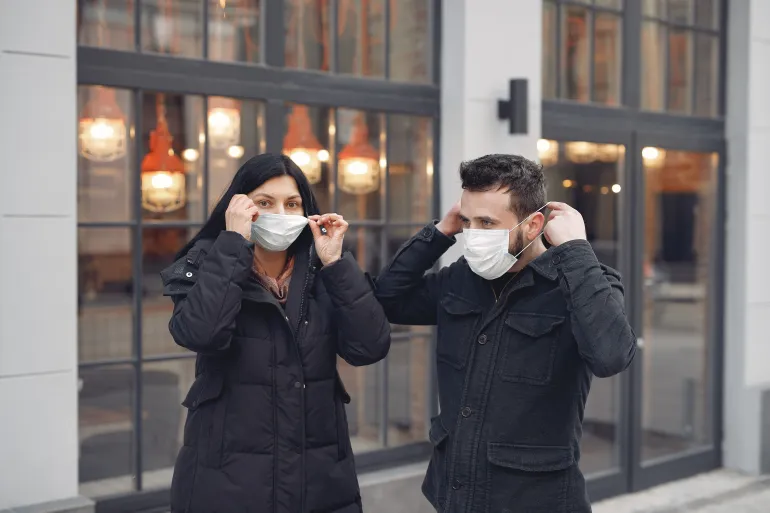
Masks in studies
Scientific studies continued with the adoption of wearing masks in various countries of the world as a preventive measure to limit infection with Corona, to evaluate the extent of their effectiveness, in light of the limited information available at the time about their real role in limiting the spread of the virus.
In January 2021, Dr. Dongluo Shi from the University of Cincinnati and his colleagues published a research review aimed at evaluating the effectiveness of masks in protecting healthy people from inhaling the virus, and not only in reducing its transmission from infected people through exhalation.
The review concluded that masks can be effective when worn correctly, especially in crowded places, with types equipped with filters capable of trapping droplets carrying germs and pathogens being superior.
The review also indicated that various types of masks, including handmade ones, can contribute to reducing the transmission of the virus and controlling infection to a significant degree.
It is noteworthy that the National Science Foundation in the United States supported and funded part of this research, which is an independent government body concerned with funding research and education in the fields of science, technology, and engineering.
In 2023, the results of the research were reinforced by a study published by researchers specializing in economics from France and Vietnam in the journal Nature, in which they used economic time series models to evaluate the effectiveness of masks in reducing the spread of Corona at the country level.
The results showed a decrease in infections by about 12% after 7 days of use, and 13.5% after 14 days, in addition to their use being associated with a decrease in death rates, which prompted researchers to recommend the use of masks to limit the spread of infection.

But other factors may have a role in reducing the reliability and accuracy of the results. The researchers indicated that their study did not take into account the medications and treatments used to combat virus infection, which means it is not possible to isolate the effect of masks from any other therapeutic interventions that may have a role in reducing the number of infections.
In continuation of previous research and in order to verify the role of masks in confronting the Corona virus, researchers from San Diego State University and other health centers in the state published in 2025 a systematic review that confirmed the effectiveness of masks and face masks in reducing the risk of infection and limiting the transmission of the virus, supporting the recommendations of health authorities and calling on countries and societies to be careful to wear masks to avoid infection, especially during the peak of the spread of the virus.
The systematic review included an analysis of data from 79 studies that addressed the effectiveness of masks in residential neighborhoods, schools, universities, and health facilities. However, the variation in types of masks, the nature of the places, and statistical methods between studies, in addition to the lack of information about the extent of adherence to wearing them, limited the possibility of conducting a “careful meta-analysis” (an analysis that compares the results of more than one study) and drawing decisive conclusions.
On the other hand, Dr. Benny Spira from the Department of Microbiology at the Brazilian University of São Paulo questioned the effectiveness of masks in limiting the spread of Corona, explaining that their success in laboratory experiments was not reflected in randomized clinical trials.
He concluded, in a study published in 2024, that the available evidence did not prove the effectiveness of masks and face masks in reducing the spread of respiratory viruses, considering that recommendations for their use were based mainly on laboratory results and observational studies, not on conclusive clinical evidence.
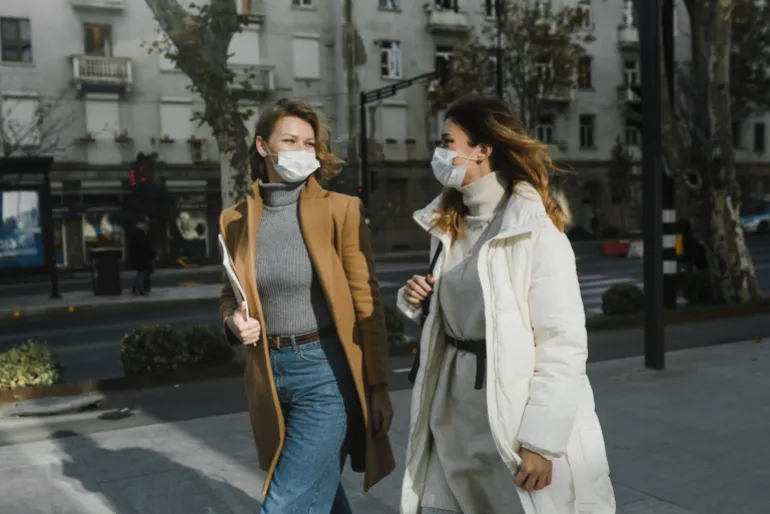
6-foot spacing: Was it effective?
With the spread of the Corona virus and the imposition of a comprehensive lockdown to limit mixing and reduce the chances of rapid transmission of infection, in August 2020, the US Centers for Disease Control and Prevention (CDC) published a study in which it indicated that social distancing can contribute to limiting the spread of the virus, but it is more effective when applied alongside other preventive measures.
As pressure increased to cancel the closure due to its economic repercussions, researchers began to evaluate the effectiveness of the recommendation to maintain a distance of 6 feet, while the World Health Organization recommended a distance of no less than one meter.
In April 2020, a review by researchers from the Chinese University of Hong Kong published in the British Medical Journal (The BMJ) concluded that social distancing was most effective when combined with other measures, such as restricting travel, closing schools, suspending transportation, and partial or complete lockdowns.
The researchers called for implementing these measures in a manner commensurate with the level of risk of transmission of the virus rather than generalizing them to all regions, given their repercussions on people’s lives.
In August 2023, a systematic review by researchers from Britain, China, and Denmark reached similar results, confirming that distancing measures helped limit the spread of Corona, but the difficulty of separating the effect of each measure separately, as the studies relied on observational data that studied the measures together, limited the strength of the conclusions.
In October of the same year, two researchers from Austria published a study in the journal Nature stating that social distancing does not necessarily lead to reducing the spread of Corona in all circumstances, and suggested that preventive measures adapt to the seasons of the spread of respiratory viruses, such that they are more stringent in the fall and winter and less stringent in the spring and summer.