


Non-surgical facial cleansing techniques have become increasingly popular because they improve the appearance and freshness of the skin, in addition to their lack of side effects and quick recovery. Expectations indicate that the non-surgical facial technology market will grow by 15.4% between 2023 and 2030.
Modern non-surgical skin cleansing techniques combine traditional methods and advanced technologies, aiming primarily to remove dirt, oils, impurities and cosmetics residue accumulated on the face.
Specialists rely on effective materials that help break down germs and pollutants and facilitate their disposal, in addition to exfoliating the keratinized surface layer of the skin, which contributes to cleaning the skin and improving its appearance.
Interest in cleaning the skin was not new. Rather, it goes back to the first humans who used stones and pieces of bone to exfoliate and clean the skin. Over time, skin care methods developed, leading to soap, which historical sources indicate appeared in the Sumerian civilization around 2000 BC, before the first bar of soap in the currently known form was manufactured in the nineteenth century, specifically in 1884 in northern England.
Revolutionizing skin exfoliation and cleansing techniques
As women, and later men, became increasingly interested in more effective ways to cleanse and rejuvenate their facial skin, dermatologists began to develop specialized skin care techniques. Chemical peeling appeared in 1871, using phenolic solutions to remove the surface layer of the skin.
In 1953, the “Dermabrasion” technique appeared, which relied on mechanical tools, such as fine brushes or diamond-tipped rotating discs, to remove the superficial layers of skin.
With an effort to improve results and reduce risks, the technique evolved in 1985 into “microdermabrasion,” using a portable device that shoots tiny crystals onto the surface of the skin to remove dead cells and the surface layer of the skin.
As for the qualitative shift in skin peeling techniques, it began in 2005 when the American company (Edge System LLC) launched a new method that combines mechanical and chemical skin peeling, what is now known as Hydrafacial.
Now, after nearly 20 years of adopting the latest skin exfoliation and cleansing techniques, have you really achieved the purpose of using them? What are the damages to which its users have been exposed? How effective is it?
Chemical peeling of the skin
Chemical peeling depends on the application of specific chemicals that work to reshape and renew the outer layer of the skin, by causing coagulation in the stratum corneum and changing the properties of some proteins in the epidermis and dermis. This stimulates an inflammatory response and the regulated release of cytokines and chemokines, which contributes to the production of collagen and elastin and skin cell regeneration, which helps improve the texture and appearance of the skin and increase its thickness.
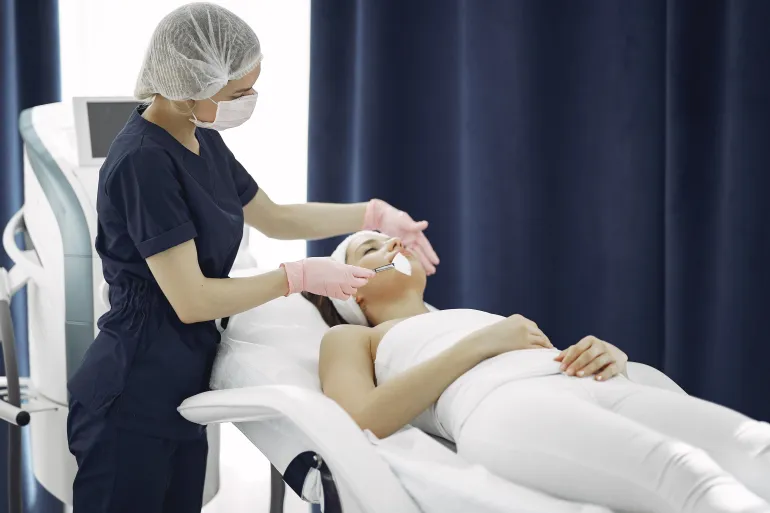
Chemical peeling can be used for multiple purposes, most notably renewing skin cells and reducing pigmentation and wrinkles, in addition to helping to treat acne and its effects by cleaning the pores and getting rid of dead cells and accumulated fats that may lead to clogging and irritation.
Chemical peeling is divided according to its depth into three types: superficial peeling that targets the outer layer of the skin (Epidermis), medium peeling that extends from the epidermis to part of the papillary dermis (Papillary dermis), and deep peeling that reaches the middle reticular layer of the dermis (Midreticular dermis).
The material used varies according to the purpose of the peeling. Glycolic acid is widely used to treat pigmentation and signs of skin aging, while salicylic, mandelic, and pyruvic acids are used in superficial peeling to cleanse the skin and treat acne and its effects.
As for cases that require deeper peeling, the doctor may resort to materials such as Jessner’s solution, trichloroacetic acid (TCA), and yellow peeling, according to the condition of the skin and the therapeutic goal.
Is chemical peeling effective?
When performing chemical peeling, the doctor takes into account a number of factors to ensure the best results, including the patient’s skin type, condition, expectations, and desire. Since the emergence of this technology, many studies and experiments have been conducted to evaluate its effectiveness in cleaning the skin, treating acne, and reducing its severity.
In 2025, researchers from the Medical University of Silesia in Poland conducted a study that included 20 patients between the ages of 20 and 25, who were suffering from mild to moderate acne, with the aim of evaluating the effectiveness of chemical peeling in improving their skin condition.
The participants underwent chemical peeling sessions using yellow peel, with two sessions separated by four weeks, and then the results were evaluated two months after the second session. The results showed a reduction in the number of inflammatory lesions by 85%, with an improvement in the appearance of prominent scars by 20%, in addition to increasing skin hydration and improving the function of its protective barrier.
Yellow peeling relies on a combination of acids and active substances, which perform multiple roles, including exfoliating the skin, reducing inflammation, bacteria, and sebum secretion, and helping to lighten pigmentation. Its most prominent ingredients are retinol, azelaic, salicylic, glycolic, kojic, and phytic acid.

Despite the remarkable results that the researchers produced, the small size of the sample and its being limited to a specific age group limits the generalizability of their findings. The experiment also did not include a control group to compare the results, and the follow-up period was short, which hinders tracking long-term effects.
Another experiment was conducted by researchers from the Department of Pharmaceutical and Therapeutic Chemistry at the George Emil Palladi University of Medicine, Pharmacy, Science and Technology in Romania and published in the magazine “Cosmetics” in January 2026. The experiment aimed to evaluate 3 procedures to reduce facial acne, and included 15 participants aged between 18 and 45 years.
The first group received chemical peeling (azelaic and salicylic acid), the second followed traditional skin care procedures using topical facial masks and manual blackhead extraction, for four sessions for each procedure, and the third group received chemical peeling with acupuncture for 7 sessions.
The results showed a noticeable improvement for people in the chemical peeling group, as the number of pimples decreased by 14% and the rate of sebum secretion (an oily, waxy substance secreted by the sebaceous glands in the skin) decreased by 17% to 18%. However, the third group that was subjected to chemical peeling accompanied by acupuncture achieved the best results, as the percentage of skin pimple lesions decreased by 22%, and the rate of sebum secretion decreased by up to 25%. In contrast, the effect of traditional skin care products was limited to reducing pimples by 8%. Only.
However, adopting the results requires conducting more controlled experiments on larger samples, as the experiment included a small number of participants, and their numbers were unequal among the different groups, and they also underwent a varying number of sessions, and all of this restricts the generalization of the results and reduces their accuracy.
Hydrafacial and chemical peeling
Hydrafacial skin technology is based on the use of a manual device that works using Vortex or whirlpool technology, by passing it over the skin, allowing it to suction dirt, fats, and materials stuck in the pores, in addition to cell residues, in conjunction with topical solutions and serums released by the device to nourish and clean the skin without scraping it.
Therefore, the hydrafacial technique does not require peeling and removing the entire surface layer, which takes days to recover, as is the case with chemical peeling. However, each of them has criteria based on which they differ in their choice.

Is hydrafacial effective for the skin?
In 2022, a group of researchers from the United States of America conducted an experiment to evaluate the effectiveness and tolerability of participants to the HydraFacial technique to cleanse the skin and improve its appearance. The experiment included 20 adults who suffer from acne and showed a noticeable improvement in the appearance of their skin after 6 sessions using the HydraFacial.
But the researchers pointed out that the experiment was unblinded, meaning that the participants knew the nature of the treatment and the researchers knew which of the participants received the treatment, which feared bias in the results and reduced their credibility and accuracy.
Two years later, in April 2024, researchers from the United States of America published the results of a new trial that aimed to evaluate the effectiveness of the HydraFacial technique in 8 participants using linear-field confocal optical coherence tomography (LC-OCT) to monitor the microscopic changes that occurred in skin tissue after the procedure.
Microscopic images of the epidermis and dermis layers were taken before the procedure, immediately after it, and then two weeks later, and showed a clear improvement in the thickness of the skin after it had decreased as a result of using HydraFacial, which means it acquired new properties that reveal its renewal and regeneration.
Harmful effects of chemical peeling and hydrafacial
Since chemical peeling has been used for many years, several studies have documented its side effects and potential complications. In 2024, American researchers monitored a number of complications in 25 patients who underwent cosmetic procedures, including chemical peeling, and included post-inflammatory hyperpigmentation, atrophic or hypertrophic scars, redness, and post-inflammatory hypopigmentation.
Other studies limited the negative effect of chemical peeling to some people trying to use chemical peeling products and solutions at home without medical supervision, warning of the consequences of this on the skin, as it may cause burns, painful wounds, and possibly permanent disfigurements.
As for the complications of hydrafacial, they are scarce in reliable studies, but they may be promoted in publications and research that is fully or partially funded by the manufacturer, which would reduce the credibility of the information received, but in general, experts indicate that the hydrafacial technique is safe and can be tolerated by many people.
Recommendation before skin cleansing procedure
Dermatologists recommend consulting experienced and specialized experts if you wish to perform a superficial or deep cleansing of the skin, in order to avoid any potential complications, or to save the skin quickly if any emergency complications arise.
Therefore, it is necessary to choose an experienced and skilled doctor, discuss all the details and share the medical history with him, while adhering to the instructions and instructions before or after the procedure.