

This year, World Patient Safety Day, which falls on September 17, comes with a different challenge. The World Health Organization chose to put the safety of people with noncommunicable diseases, or chronic diseases, at the heart of its 2026 campaign under the slogan “Safe care for life.”
The importance of the slogan stems not only from the size of these diseases, but also from their nature. A patient with diabetes, heart disease, cancer, or chronic respiratory disease may need continuous care for years, moving between diagnosis, treatment, follow-up, medications, and self-care. These stages open every time a door to the possibility of error, interruption of treatment, or delayed diagnosis.
The World Health Organization says that this year’s campaign aims to raise awareness of the risks of care safety associated with noncommunicable diseases, involve patients themselves in identifying risks and solutions, support health workers in the areas of safe diagnosis and drug safety, in addition to integrating patient safety into health policies and programs and strengthening the role of primary health care.
43 million deaths in one year
The campaign comes amid a heavy global burden of noncommunicable diseases. According to the latest data from the World Health Organization, these diseases caused the death of at least 43 million people in 2021, equivalent to about 75% of global deaths not related to epidemics.
Of these, about 18 million people died before reaching the age of 70, and 82% of these premature deaths occurred in low- and middle-income countries.
Cardiovascular diseases topped the list with about 19 million deaths, followed by cancers with about 10 million, then chronic respiratory diseases with about 4 million, and diabetes with more than two million deaths, including deaths resulting from kidney diseases associated with it.
These diseases are not linked to a single factor, as multiple behavioral and environmental factors play a role in their emergence, including smoking, physical inactivity, unhealthy diets, harmful use of alcohol, and air pollution. These factors are reflected in high blood pressure, blood sugar, lipid disorder, overweight and obesity.
A burden that exceeds global numbers
The picture appears more complex in the Eastern Mediterranean region, which includes 22 countries and territories, including the majority of Arab countries. World Health Organization data indicate that more than 2.8 million people die annually in the region due to major noncommunicable diseases, while these diseases were responsible for about 66% of all deaths in the region in 2019.
The probability of premature death due to noncommunicable diseases before the age of seventy in the region is about 22.7%, which is one of the highest rates among the regions of the World Health Organization. The organization says that only 36% of countries in the region reported the availability of noncommunicable disease services at the primary health care level.
The crisis is not the result of recent years. In 2012, the death rate from noncommunicable diseases in the Eastern Mediterranean reached 654 deaths per 100,000 people, compared to 539 deaths per 100,000 globally, according to a study published in the journal Frontiers in Nutrition.
Part of this burden is linked to lifestyle changes, including increased consumption of foods high in sugar, fat, and salt, lack of physical activity, and urbanization, in addition to the spread of smoking, obesity, and blood pressure and blood sugar disorders.
When war interrupts the chain of treatment
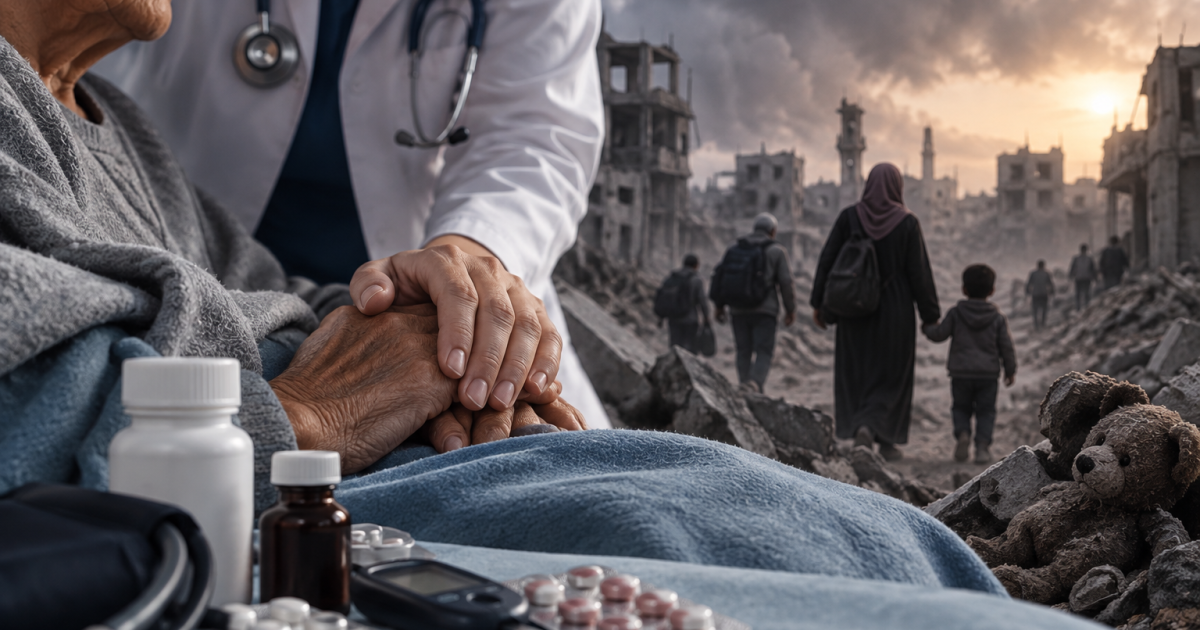
If managing chronic illness is difficult in a stable health system, the challenge becomes even greater in zones of war and displacement, where loss of medication, hospital disruption, or difficulty accessing a doctor can turn a stable illness into an emergency.
The World Health Organization says complications from noncommunicable diseases, such as heart attacks, strokes and asthma attacks, may become up to two or three times more common in emergency situations than in stable areas. The premature death rate due to these diseases in emergency settings was 25.1%, compared to 17.8% in non-emergency settings.
These numbers are particularly important in the Eastern Mediterranean, which currently bears the largest humanitarian burden in the world. In 2026, about 115 million people in the region need humanitarian assistance, i.e. nearly half of those in need of aid in the world.
The effects of this are clearly visible in health systems affected by conflict. In the Gaza Strip, the World Health Organization reported in May 2026 that no hospital was fully operational, and that more than half of essential medicines were out of stock. In Sudan, about 37% of health facilities are still out of service after years of conflict.
For a patient who needs daily insulin, regular blood pressure medications, dialysis sessions, or cancer treatment that cannot be interrupted, the safety of care here turns from a theoretical concept into a matter of survival.
Were the confrontation plans successful?
WHO’s efforts on noncommunicable diseases do not start with the 2026 campaign. In 2013, the organization launched the global action plan to combat these diseases for the period 2013-2020, one of whose goals was to reduce premature deaths from major diseases by 25% by 2025.
With progress slowing, the World Health Assembly extended the plan to 2030, in line with the Sustainable Development Goal that seeks to reduce premature deaths from noncommunicable diseases by a third by that year.
But the gap between formulating plans and the ability of health systems to implement them is still wide in the Eastern Mediterranean.
In a systematic review published on March 17, 2026, which included 50 studies published between 2010 and 2024, researchers found significant disparities in the progress achieved between countries in the region.
The review showed that Turkey, Qatar and the UAE have developed national action plans and more advanced measures to combat noncommunicable diseases, including anti-smoking policies, screening and early detection, and integration of services into health systems.
On the other hand, the review classified Egypt, Lebanon, and Iraq among the countries that face weaker levels of policy development or implementation, and researchers linked this to factors including instability, weak executive capacity, and pressures on health systems.
But the researchers also warned against overgeneralizing the results, due to the differences in study design, sample sizes and quality, in addition to the presence of large data gaps, especially in low- and middle-income countries, and the absence of unified monitoring systems that allow accurate comparison between countries in the region.
Patient safety begins before the hospital
This reveals that awareness campaigns, although important, are not sufficient alone to protect people with chronic diseases. Safe care requires early diagnosis, constantly available medication, an accessible doctor, and a system that follows up with the patient after they leave the hospital, as well as educating them about treatment and potential complications.
The task becomes more difficult when this chain is interrupted by displacement, war, poor funding, or lack of medicines.
Hence, the slogan “Safe Care for Life” appears to be more than just an awareness message on a global day; It puts health systems to a practical test: Can a patient who needs treatment today find it tomorrow, a month later, and years later?
For millions of people affected by noncommunicable diseases in the Eastern Mediterranean, the answer to this question may be the true measure of the campaign’s success.