

Tripoli- Hanaa Boudbous did not need to ask her sister Fatima how she felt. One look was enough to realize the extent of the pain and fear that she was trying to hide, especially when her stay in the hospital extended for more than 12 days, after Fatima’s immune and iron indicators decreased, and one of the chemotherapy doses was postponed.
The days were heavy, waiting for treatment, physical exhaustion, and anxiety about what the upcoming tests would bring. And every time Fatima tried to look strong, her eyes revealed to her sister something that words could not say.
Fatima, a teacher and mother of 3 children, is one of the Libyan women who faced breast cancer, but her battle was not with the disease alone, but with fear of the future, the changes that occurred in her body, and her continuous attempts to maintain her cohesion in front of her family.
After 6 months of chemotherapy, followed by radiotherapy, the moment that the family had been waiting for a long time came, when the atomic scan showed no visible signs of the disease.
But the end of treatment did not erase the traces of the trip from the memory of Fatima and her sister, and the two sisters’ experience opens a window on an aspect that may be missed in stories of cancer recovery, which is the psychological price that patients and those who accompany them pay.
The International Agency for Research on Cancer estimates, according to the data of the World Cancer Observatory for the year 2024 published in September 2026, that 913 new cases of breast cancer have been recorded among women in Libya, representing 23.7% of the estimated cases of cancer in women, in addition to 331 deaths from the disease.
When eyes speak
Speaking to Al Jazeera Net, Hana recalls the most difficult days of her sister’s treatment, when finding a suitable vein to give her treatment took a long time, adding new psychological suffering to her physical exhaustion.
Pain was not the only thing that weighed on those days, as watching other patients suffering inside the hospital increased the fear of the unknown, while Fatima continued her attempts to hide her anxiety and maintain her strong image in front of those she loves.
Hanaa says that her sister was not inclined to talk about her fears, but she understood many of her looks and silence.
Fatima found prayer, reading the Qur’an, praising God, and performing voluntary prayers to help her endure the days of treatment. Her desire to stay with her children, and to see them graduate and get married, was an incentive to continue the journey despite its harshness.
With the support of her husband, children, relatives and friends, Fatima faced one of the most difficult experiences in her life, but some transitions were more difficult for her than others.
When her hair began to fall out as a result of the treatment, she made sure to cover her head, and for a long time refused to appear without a cover.
Hanaa did not try to force her sister to accept her new appearance, nor did she ask her to get over her sadness quickly, but rather respected her need for time and silence.
From this experience, Hana emerged with the conviction that supporting a cancer patient does not mean overwhelming her with pity or asking her to be brave all the time, but rather giving her love, reassurance, and the right to express her weakness without fear.
Wounds that tests do not show
Dr. Lea Al-Sayed, a psychiatrist, explains to Al Jazeera Net that a diagnosis of breast cancer may provoke overlapping feelings of fear, anxiety, anger, and denial, especially for those in whose minds the disease is associated with death or loss of control over the future.
The psychological repercussions are not limited to the moment of diagnosis, but may extend throughout the treatment period, with physical changes, hair loss, fatigue, and the accompanying disturbance in the woman’s image of herself, her sense of femininity, and her relationship with her life partner.
The doctor points out that the patient’s feelings may fluctuate between hope and fear, between cohesion and collapse, and that these fluctuations do not necessarily mean a weakness in her ability to confront the disease.
She emphasizes that effective family support begins with listening without judgment, and asking the patient what she needs, rather than assuming how she should feel or pressuring her to remain constantly optimistic.
Although Fatima did not resort to a psychologist during her treatment, due to her reservations about revealing her feelings, Dr. Leah stresses the importance of seeking specialized help if sadness or anxiety persists and affects sleep, social relationships, and the ability to perform daily tasks.
It should be noted that the end of treatment does not necessarily mean the end of psychological suffering, as the fear of the cancer returning may persist even after reassuring medical results appear.
Suffering in the shadows
While the attention of those around Fatima was focused on her health condition, Hanaa was also going through a difficult psychological experience.
She says that she did not find anyone to ask her about her psychological state as a companion of a cancer patient, despite the anxiety and stress she endured and daily witnessing of her sister’s suffering.
Inside the hospital, I found some support from other female companions, who were exchanging conversations and checking on each other’s conditions, in an attempt to ease the burden of the long days.
Through women who came from different Libyan cities to accompany their patients, Hanaa realized that the cancer journey does not exhaust the patient alone, but rather its effects extend to those around her, and that the person who gives others strength may also need someone to support him.
A surgeon in family memory
In another experience, Rayan Tantoush carries childhood memories associated with her mother’s illness with breast cancer in 2009.
Rayyan was young when her mother had to travel for treatment for nearly a full year, leaving behind a family trying to adapt to absence and fear.
The mother’s return home was not an easy end to that stage, as her appearance had changed due to illness and treatment, and her hair had fallen out, to the point that her youngest daughter did not recognize her at first.
The situation was painful for the mother who returned after a long treatment trip, only to find that the effects of the disease extended even to the way her children received her.
With recovery, anxiety remained present in the family’s life, renewed with every appointment for periodic examinations for fear of the disease returning.
In 2019, the family faced a new test when the father contracted cancer, before he also recovered, and this time the mother, who had experienced the harshness of the experience, was at the forefront of those who supported him.
Rayyan says that her feeling of helplessness to help her mother as a child was one of the motivations that led her to study medicine.
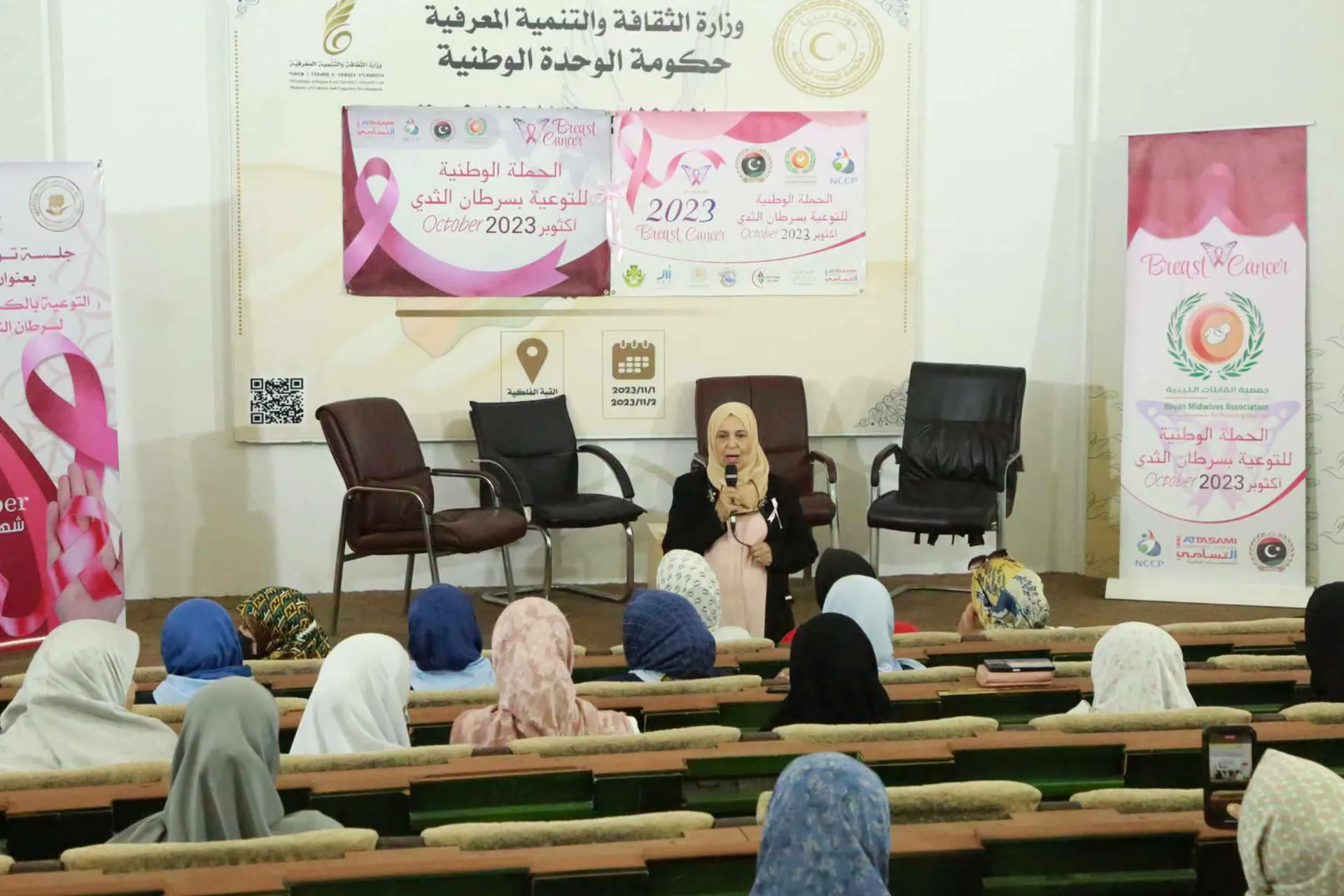
Today, she works as a sales manager in a medical devices company, and seeks to contribute to supporting early detection of breast cancer, through an initiative to reduce the prices of devices and train medical personnel on the occasion of Pink October.
Thus, the experience of illness, which left a scar on a child’s memory, turned into a professional and humanitarian motivation to try to help others.
Late discovery
Calls for early detection are particularly important in Libya, where a summary of a pilot project, presented by researchers from the National Cancer Institute in Misrata and the International Agency for Research on Cancer in May 2026, indicates that about two-thirds of breast cancer patients are discovered in advanced stages.
In the first four months of a pilot early detection program in the city of Misrata, 364 women underwent clinical examination, and 6 infections were diagnosed, 5 of which were in the first and second stages.
These preliminary results highlight the importance of expanding opportunities for early detection and facilitating access to diagnostic and treatment services, in a country where many women face the burden of the disease and its psychological and family costs.
Every early diagnosis may give the patient a better chance for treatment and reduce some of the burdens on her family, although it does not eliminate the difficulty of the experience or the need for continuous support.
After cancer…the story remains
Today, after Fatima has passed the stages of treatment and received reassuring test results, Hana still recalls those days when she used to read the pain in her sister’s eyes, without hearing a complaint from her.
Much has changed since that time, but the experience left the two sisters with a deeper understanding of the meaning of support, and that recovery is not measured by test results alone, but also includes restoring reassurance and reconciling with the body and life.
Hana summarizes what she wants to say to every woman facing the disease, and to every family who accompanies her on her journey, with a message that carries a lot of her personal experience:
“You are strong, and this is a warning bell for you to take care of your body psychologically and spiritually. All stress in life is fleeting, and it is not worth burning inside you for it. You are a blooming rose.”