

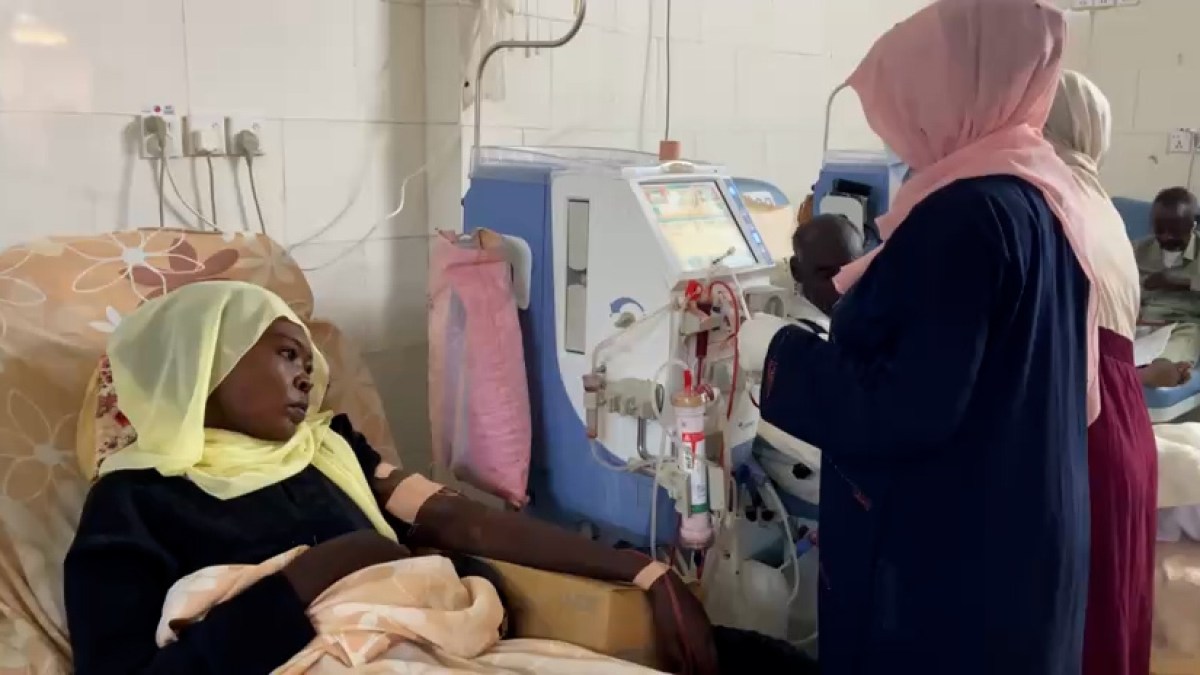
The family of Ibrahim Al-Taher will not be able to forget the dark days it lived under the burden of great suffering, after the Rapid Support took control of the city of Sinja, the capital of Sennar State, at the end of last June, when the entry of members of those forces coincided with the scheduled dialysis appointment of the head of the family, Ibrahim, who suffers from kidney failure.
Muhammad Ibrahim tells Al Jazeera Net with great sadness how the family was forced to collect money from relatives outside Sudan through an electronic payment application in order to be able to rent a vehicle to transport his father to the city of Dinder, where the dialysis center attached to the hospital is located there.
When they were able to arrive and the doctors began arrangements for the washing procedure, the Rapid Support Forces stormed the city, besieged the hospital, and assassinated one of the medical staff, prompting the workers at the washing center located east of the hospital to stop working without any arrangements to complete the treatment of those waiting.
Muhammad says that they did not find an ambulance to take his father to the city of Gedaref, the nearest treatment point – after the Rapid Support took control of the main bridge in Dinder and a state of panic spread with random shooting, so they were forced to carry him on a bed they found near the market.
He continued: “We carried my father on the bed in the hope that we would find a car, but to no avail. This coincided with the rainy season, knowing that the road between Dinder and Gedaref is dirt.” After walking for several hours on foot, Muhammad says, we found a tractor with a vehicle attached to it crowded with fleeing people. Some of them gave up their place to transport his father, but the father could not bear the harshness of the road and died before reaching Gedaref.
Thousands of tragedies
Ibrahim’s tragedy is one of thousands of tragedies that befell people with chronic diseases as a result of the repercussions of the war in Sudan, which forced at least 10 million Sudanese to be internally displaced or leave the country.
In the midst of forced flight, patients lived in difficult situations, dealing with the bitterness of displacement, the pain of illness, distress, and fear of an uncertain fate.
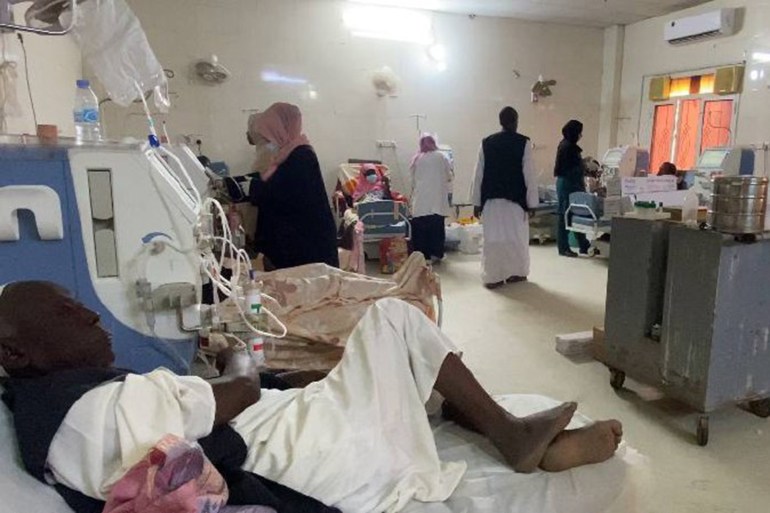
In Port Sudan, east of the country, Al Jazeera Net monitored the suffering of dozens of kidney patients, as the centers were forced to reduce the number of dialysis to cope with the increased pressure with the influx of patients from states witnessing fighting. A number of patients also spoke to Al Jazeera Net about problems in obtaining medications due to their scarcity and interruption, or High prices.
Cancer, diabetes, kidney and heart diseases are the most common chronic diseases, and the elderly suffer most from them, who find it difficult to move from one place to another, and their fate is a slow death, especially in light of the destruction of 80% of health institutions in Sudan as a result of the fighting.
The director of the National Centers for Oncology Treatment in Sudan, Dafallah Abu Idris, told Al Jazeera Net that at least 20% of cancer patients died in their homes or in the centers, due to the lack of treatment or the difficulty of leaving their areas of residence, and he points out that 80% of the patients were receiving treatment in The centers of Khartoum and Gezira states, but they stopped working as the fighting expanded and the centers were destroyed.
Abu Idris points out that treatment centers in the currently safe states lack radiotherapy, which is important for 70% of patients, adding, “This is the biggest problem facing cancer patients.”
Facing illness until death
The official finds it difficult to determine the numbers of the current frequency of patients in the operating centers, attributing this to the fluctuation according to the map of the displacement of families. Some of them, as he explains, visit a center in Gedaref and then move to other cities, and then the patient is registered in more than one center. He continues, “There are patients who register and then disappear, often migrating abroad.” Sudan or they passed away…we do not know the truth.”
Abu Idris goes on to say that the extent of the losses known to us is the human tragedy for cancer patients, especially since those who were unable to emigrate had to face the cruelty of the disease until death. Likewise, for those who were displaced, the state could not provide them with living aids, even if we assume the availability of treatment, which makes them live an endless nightmare. He continues, “The state is of course in a critical situation and is facing challenges the size of a continent…but organizations must help provide adequate housing for patients’ families so that they can continue treatment without suffering and displacement.”
In another aspect of the suffering, Dr. Weam Al-Sharif speaks to Al Jazeera Net about the great suffering of patients with high blood pressure and diabetes as a result of the interruption of treatments and the rise in their prices if they are found, with the cessation of health insurance services that used to provide many treatments for people with chronic diseases for free.
She talks about how her period of work at Al-Hasahissa Hospital, before the RSF invasion, witnessed a horrific shortage of medicines and patients were forced to buy insulin doses from the black market, where the value of the serum reached about 10 thousand pounds (about 5 dollars), while some patients may need more than one dose per day. The one.
Later, the Rapid Support took control of the hospital, so most of the specialist doctors left and the forces resorted to seeking the help of non-specialized personnel, and the hospital began to deal with medicines looted from other locations, as treatments do not reach the areas under the control of the Rapid Support, which leads – as Weam says – to deaths. In high numbers.
Severe shortage of life-saving medicines
Regarding heart patients, Weam explains that they are diverse. Some of them were exposed to chest attacks and were received in emergency departments where first aid was available. After their conditions stabilized, they were sent to a civil hospital, where the nature of the condition was determined and whether it needed surgical intervention or not, but all of that stopped. As the fighting expands to Al-Jazira State, the fate of thousands of patients is unknown.
According to Adiba Ibrahim, a member of the preliminary committee of the Sudan Doctors Syndicate, who spoke to Al Jazeera Net, the health situation in all states of Sudan faces a severe shortage of life-saving medicines and medical and laboratory solutions, with the absence of important tests for blood and diabetes from government facilities, in addition to the lack of special medicines. Chronic diseases and other necessary medications, with some of them available in private pharmacies at high prices. Hospitals and dialysis centers were also closed because they ran out of solutions used in weekly dialysis.
She adds that all of this has led to the suffering of patients, their weakened immunity, and exposure to epidemic diseases spreading in the country.
Adiba called on both sides of the conflict to stop the war and open safe corridors to transfer patients, especially the elderly, children, pregnant women, and those with chronic diseases, to the nearest hospitals to receive treatment, and also provide all life-saving medicines in the remaining hospitals and health centers.