


A group of researchers at the British University of Cambridge were able to clarify the exact relationship between Barrett’s esophagus and esophageal adenocarcinoma.
Barrett’s esophagus is a disease condition in which the lining of the lower esophagus changes, transforming into tissue similar to that found in the intestine, as a result of chronic exposure to stomach acids, especially in patients with gastroesophageal reflux disease.
This change is not cancerous in itself, but it is important because it may be the first stage that precedes esophageal adenocarcinoma.
The disappearance of Barrett cells in patients with this type of cancer upon diagnosis has remained a mystery that has puzzled scientists for nearly two decades, despite the presence of evidence confirming the association of these cells with the development of esophageal adenocarcinoma.
A recent observational study published in the journal Nature this April, led by Professor Rebecca Fitzgerald, revealed indications that support Barrett’s esophagus as a predictive marker for esophageal adenocarcinoma, making it a potential tool for early detection of this type of cancer.
Fitzgerald is a prominent British researcher and physician in the field of cancer prevention and early detection, and holds the position of Professor of Cancer Prevention and Director of the Early Cancer Institute at the University of Cambridge. It is considered one of the scientific figures that has transformed the examination of esophageal and stomach cancer through its pioneering diagnostic innovations.
The study, which included 3,100 patients, was divided into two groups: the first included patients who clearly had Barrett’s cells, and the second without any evidence of their presence.
The researchers relied on analyzing the clinical and epidemiological data of the participants, in addition to conducting genomic sequencing of samples from 710 patients, with the aim of exploring the genetic aspects associated with the origin of the disease.
Unraveling the path of development of esophageal adenocarcinoma
Researchers hypothesized that there is more than one path to understand the origin of cancer cells in the esophagus. They believe that there are two main pathways that may provide a primary explanation for the development of esophageal adenocarcinoma.
- The first path assumes that the disease may arise with or without the presence of Barrett’s esophagus in patients, which indicates a difference in genetic factors and risk factors between them.
- The second pathway raises the possibility that there is a single common starting point for the disease, which means that genetic characteristics and risk factors are similar in patients, thus supporting the hypothesis that Barrett’s esophagus represents the primary pathway for the development of this type of cancer.
What did the results show?
No genetic differences appeared between the cancer cells after examining them and discovering their characteristics and the genetic material inside them, and this supports the second hypothesis that Barrett’s condition is the source of esophageal adenocarcinoma.
But what is striking is that only 35% of patients were found to have Barrett’s esophagus, while the rest’s tests were negative and did not show any signs of Barrett’s esophagus, especially for advanced cases of cancer.
In their quest to explain these data, the researchers revealed proteins called TFF3 and REG4 that were present in the esophageal cells of all patients even before the cancer arose in them. This means – according to the researchers – that the cancerous tissues devoured the Barrett cells and destroyed them during their growth. As the cells multiplied and spread, the Barrett cells decayed and disappeared, so they were not found in advanced cases of esophageal adenocarcinoma.
Dr. Shahriar Zamani, one of the lead researchers in the study, confirms that esophageal adenocarcinoma follows a single path through Barrett’s cells, which means that one of the ways to prevent it begins with fighting and treating Barrett’s esophagus.
The study also resulted in a recommendation to rely on TFF3 and REG4 proteins as one of the promising diagnostic biomarkers to predict the probability of developing esophageal cancer.

Previous studies confirmed and supported
This study comes as a continuation of previous studies that investigated the origin of esophageal cancer cells and attempted to understand the mysterious relationship between the increased risk of Barrett’s esophagus and esophageal adenocarcinoma specifically.
One of the most prominent of this research is what the same researcher – Professor Fitzgerald – published with her team in 2021 in the journal Science about the origin of esophageal adenocarcinoma cells. The study revealed a series of changes that the cells at the top of the stomach – called the gastric cardia – undergo, gradually transforming into what are known as Barrett cells, which may begin cancerous proliferation, causing esophageal adenocarcinoma.
The study did not reveal at the time the reason for the disappearance of tangible evidence indicating Barrett’s condition before esophageal cancer, but it confirmed that it may be an indicator that detects the disease early, given its role as an inevitable and main mediator in the transformation of Barrett’s esophagus into esophageal adenocarcinoma.
The researchers relied on analyzing tissue samples from the lower esophagus – between the stomach and the esophagus – from people with esophageal adenocarcinoma, people with Barrett’s esophagus, and other healthy people, and then used advanced techniques to conduct genetic analyzes and reveal the origin of the cells.
The results showed an unexpected similarity between stomach tissue and Barrett’s cells, which means – according to the researchers – that all esophageal adenocarcinoma cells start from gastric cells before undergoing genetic mutations led by the c-MYC gene and the HNF4A gene that push them to undergo radical transformations to assume the identity of intestinal cells despite their presence above the stomach on their way to forming Barrett’s tissue and cells.
What is Barrett’s esophagus and how common is it?
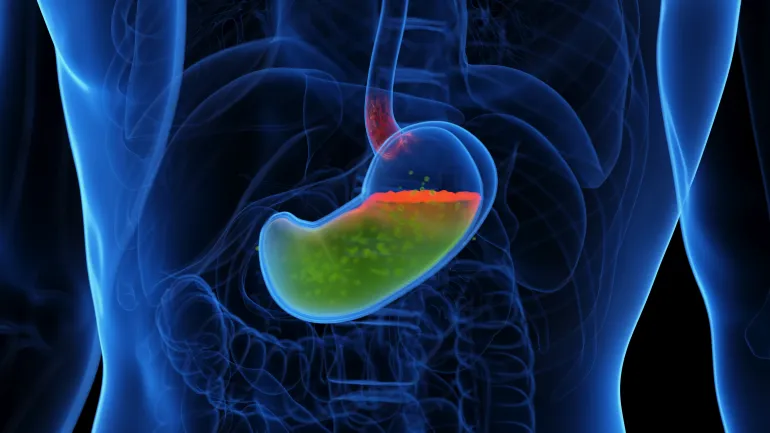
Barrett’s esophagus is a disease that affects about 0.8% of people around the world. The lining of the lower esophagus changes, with mucous tissue appearing in a reddish-pink color that extends for a distance of not less than one centimeter near the point where the esophagus connects to the stomach.
Although this condition is not cancer, less than 5% of people with it may later develop into esophageal adenocarcinoma, which makes it the subject of great medical interest.
The main reason: chronic reflux
Doctors believe that the most important cause of Barrett’s esophagus is chronic gastroesophageal reflux, which accounts for about 15% to 20% of cases.
When the cells of the esophagus are constantly exposed to stomach acids, permanent irritation occurs that leads to a change in the nature of these cells, so that they turn into cells that resemble intestinal cells and perform functions similar to them, which are known as goblet cells.
Can Barrett’s esophagus be avoided?
Despite the many treatment options available for Barrett’s esophagus, it is difficult to determine the most effective among them due to the absence of evidence to support this so far. However, the abundance of scientific indicators that enhance the risk of Barrett’s cells transforming into esophageal adenocarcinoma and confirm that it is the first step to it, has now necessitated the need to know the factors that cause Barrett’s esophagus in order to try to avoid them and thus reduce the risk of developing esophageal adenocarcinoma.
According to a large Japanese study that included more than 600,000 people conducted by a group of researchers and whose results were published in the journal Nature in February 2026, a group of factors confirmed their association with Barrett’s esophagus independently of any other effects:
- Gastroesophageal reflux.
- Esophageal hiatus hernia.
- Peripheral vascular disease.
- Liver disease.
- Helicobacter pylori infection.
- Use of stomach acid-suppressing medications for long periods.
The infection rate has also increased among men and people between the ages of 50 and 79 years, which means that aging is one of the influencing factors. While some of them cannot be avoided, such as age and gender, others can be avoided by making sure to conduct periodic examinations to detect some problems that may not be accompanied by clear symptoms.
It is noteworthy that the study gave an impression of one of the Asian countries – represented by Japan – and the association of certain factors with Barrett’s esophagus, but the prevalence of a certain type of Barrett’s esophagus (short-segment BE) among the Japanese population, in addition to the lack of histological data that allows distinguishing between the two types of Barrett’s esophagus (short and long), makes it one of the weak points that may limit the generalization of the results of this study.