

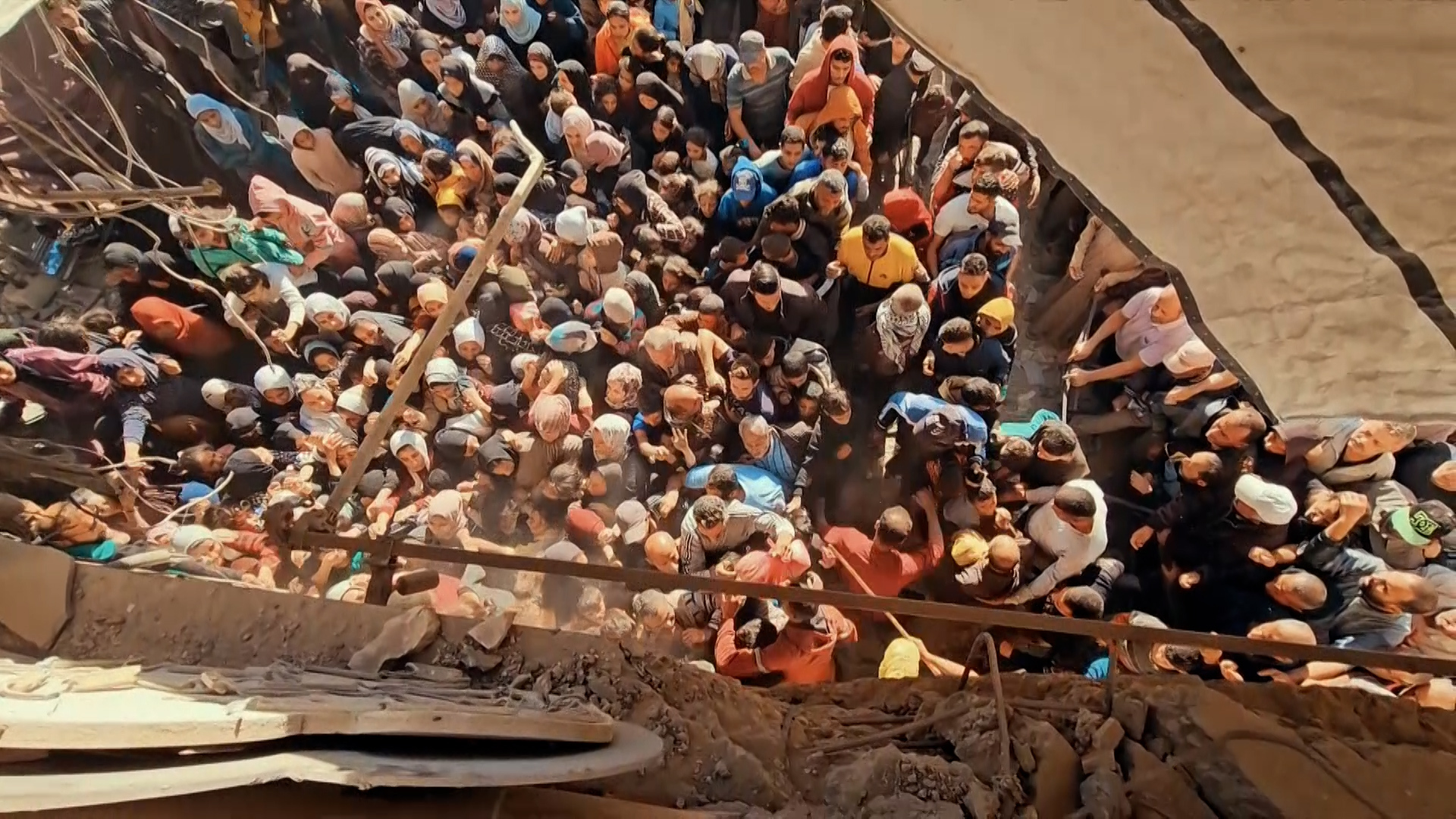
Abdul Karim Hamdan lost more than half of his weight during the 440 days of the ongoing deadly Israeli war on the Gaza Strip, reaching 50 kilograms from 96 kilograms, as a result of famine and the absence of many basic foods from the markets, most notably flour, and the Israeli occupation stopping their entry.
The situation reached the point of Abdul Karim, and his family, which consists of 4 children and his wife, eating one meal a day due to the lack of meat, fish, vegetables, fruits, and eggs in the markets. Their food was limited to canned goods that are still provided by some relief institutions, and some wild plants that are still grown by residents. The sector depends on rainwater.
Abdul Karim only finds in the markets products of ketchup, mayonnaise, sliced mushrooms, Nescafe, cappuccino, pickles, and poor types of vegetarian cheese, oats, and canned corn, which the occupation authorities allow to be brought in through the Kerem Shalom crossing, while tightening restrictions on basic foods that contain vitamins and proteins.
Systematic starvation
From the first day of the bloody war on the besieged Palestinian Strip, Israel announced that one of its goals was to starve the residents of this small area. This is what former Defense Minister Yoav Galant said: “There will be no electricity, no food, no fuel. Everything is forbidden… We are fighting human animals, and we will act accordingly.” “So.”
After this statement, the occupation army closed all crossings with the Gaza Strip, and prevented the entry of trucks carrying goods and aid, which before the war was estimated at 500 trucks per day.
In the face of international pressure, the occupation army re-entered aid trucks from the Rafah land crossing before taking control of it on October 21, 2023, and established a complex mechanism to bring food supplies into the Strip, where the trucks go from inside the Egyptian Rafah crossing to the Kerem Shalom crossing and there they are searched. Then you enter the sector.
The occupation army allowed the entry of only 20 trucks daily from the Rafah crossing, and after taking control of it last May, it now controls everything entering the Strip through the Kerem Shalom crossing.
From time to time, Israel deliberately tightens its restrictions on the Kerem Shalom crossing and closes it to the entry of goods. This has a rapid impact on the displaced and residents of the Strip, with the markets empty of anything to eat for long weeks.
Starvation of fetuses
In her displacement tent in the Al-Mawasi area, west of Khan Yunis, south of the Gaza Strip, Palestinian Hanin Barbakh (25 years old) suffers from the lack of healthy food necessary for her and her fetus, especially since she is in the first months of her pregnancy.
Haneen’s body shows signs of malnutrition, and she suffers from dizziness from time to time, lack of concentration, skin infections, lack of balance while doing her household chores inside her tent, and toothaches.
In a faint voice, the twenty-year-old woman told Al Jazeera Net, “This is my second pregnancy, and it came at a time when we are living in a real famine. There is no flour available to produce bread, nor even vegetables or fruits, or meat and fish, and nutritional supplements have become scarce.”
She remembers her first pregnancy, which was before the war, during which she received health and nutritional care, and received nutritional supplements in addition to her basic food, which contains proteins, vitamins, carbohydrates, and the rest of the elements necessary for the body.
During her second pregnancy, famine was not the only burden that weighed on her, but also the large number of displacement, the falling of missiles near the place of her displacement, the absence of health care, and her sleeping on many days without dinner.
famine
The head of the therapeutic nutrition department at Nasser Medical Complex, Dr. Ayman Abu Tir, confirmed that the residents of the Gaza Strip are suffering from famine at varying levels.
International and humanitarian law defines famine, according to Abu Tir, as an acute food shortage that leads to widespread suffering among the population, and is used as a weapon in countries where conflicts occur.
This definition, according to what Abu Tair told Al Jazeera Net, matches the situation in the Gaza Strip completely, as Israel deliberately plunged the Gaza Strip into a famine, and it actually implemented that.
Abu Tir conducted a scientific study targeting more than 1,200 families from all governorates of the Gaza Strip in the north and south, and the results were that 100% of families suffered from famine of varying degrees, severe or moderate.
One of the most prominent results of the study conducted by Abu Tair is that the average weight loss for the head of a family ranges from 10 to 30 kilograms, and varies according to the severity of the existing famine, the rates of repeated displacement, the spread of diseases, and the lack of personal hygiene due to the lack of detergents.
According to Abu Tair, weight loss for hungry people in the Gaza Strip is considered unnatural, and medically it is called unintentional weight loss, and this leads to the loss of muscle mass, subcutaneous fat, and fat in the organs.
In the short and long term, unintentional weight loss, according to Abu Tir, causes a complete decline in some important minerals and vitamins that may lead to future diseases, such as a deficiency of vitamin B12, which is found in meat and dairy products.
Abu Tair warns that a lack of vitamin B12 in the body leads to diseases of the nervous system, and in advanced stages it may lead to paralysis.
He confirms that the occupation army prevents the entry of basic types of food into the north and south of the Gaza Strip, which are starches, proteins, fats, minerals and vitamins, which allow keeping humans alive, most notably flour, vegetables, meat, sugar and oil, and allows their entry at long intervals.
The famine has caused multiple cases of malnutrition among vulnerable groups, namely: children, pregnant women, breastfeeding women, the elderly, and those with chronic diseases, according to what Dr. Abu Tair said.
Calories
According to Abu Tir, an adult person needs from 1,800 to 2,500 calories, depending on his weight, 30 calories per kilo of the person’s body weight per day.
Abu Tir also conducted a study on a group of citizens from random points in the northern and southern Gaza Strip, and found that they only receive from a third to a half of their daily energy needs.
Israel has used the weapon of starvation against the Gazans since the beginning of the siege on the Gaza Strip in 2007, and at that time it precisely determined the amount of calories for each individual in the Strip.
The Israeli authorities’ intentions to starve were revealed through a document entitled “Red Lines” following its imposition of the siege on the Gaza Strip in 2007.
The document – which was revealed by the Israeli newspaper Haaretz in December 2023 – included what foodstuffs are allowed or prohibited to be brought into the Strip, through very precise calculations of the minimum amount of daily calories that must be allowed to enter the Strip without causing famine. .
According to the document, Israel conducted calculations of the weekly and monthly quantities of food supplies, and then the number of trucks that are allowed to enter the Gaza Strip, so that 170.4 trucks can be entered daily, of which 68.6 trucks whose load is equivalent to the amount of local agricultural production are reduced, bringing the number of trucks that can be entered into the Strip to 101.8 truck.
According to the newspaper, Israel estimated the minimum daily number of calories that it must allow into Gaza without risking famine, according to a precise measure during its imposition of the siege on the Strip in 2007, and then derived weekly and monthly data that then determined the number of aid trucks that would be delivered. Entry must be allowed.
Currently, the conditions of famine – which accompanied the genocidal war on the Gaza Strip – have led to more severe complications for Gazans and deprived them of the basics of survival.
Regarding this food plan, the commander of the Israeli military unit – who is the coordinator of government activities in the occupied territories – admitted that calculating the exact amount of food supplies is aimed at “ascertaining” that there will be a famine due to a shortage of food supplies.
Israel has continued to rely on these “red lines” and the “calorie list” that they have included since 2007, even though the population of the Gaza Strip that year was approximately 1.4 million people, while their number has now risen to about 2.3 million people.
Contrary to what was stated in the document, the Gaza Strip lost its full capacity to produce local agricultural or marine foodstuffs or any other foodstuffs, which were complementary to calculating the quantities of foodstuffs allowed for entry.
Stopping food and medicine
For his part, Amjad Shawa, director of the Palestinian NGO Network, confirms that the Israeli occupation took a decision from the beginning of the aggression on the Gaza Strip to stop food and medicine.
He said in an interview with Al Jazeera Net, “The quantities of aid and food supplies entering the Gaza Strip are barely sufficient for 5 to 7% of the population’s needs, and in the last three months there have been major restrictions on entering what the Strip needs, and this has caused social kitchens to stop working.”
Shawa explained that severe malnutrition is evidence of the poor humanitarian conditions in the south, center and north of the Gaza Strip, in light of the inability of the health system to deal with these cases.
According to Shawa, the starvation of the residents of the Gaza Strip by the Israeli occupation authorities is deliberate and systematic by carefully determining the quantities of food that are allowed to be brought into the Strip, and controlling the calories of the population.