

Something has changed in the World Cup this time. Less than 48 hours separate us from the tournament hosted by the United States, Canada and Mexico, and the state of anger and the insane rise in ticket prices for World Cup matches is still at the top of search engines.
The World Cup is a tournament that is supposed to unite the peoples of the earth under the banner of football, but it has become closer to an open stock exchange, in which those who are able to buy a seat in the stadium compete, not to live the moment itself, but to struggle to obtain the price of a ticket for the matches. Thus, the 2026 World Cup enters an unprecedented area in football’s relationship with its fans.
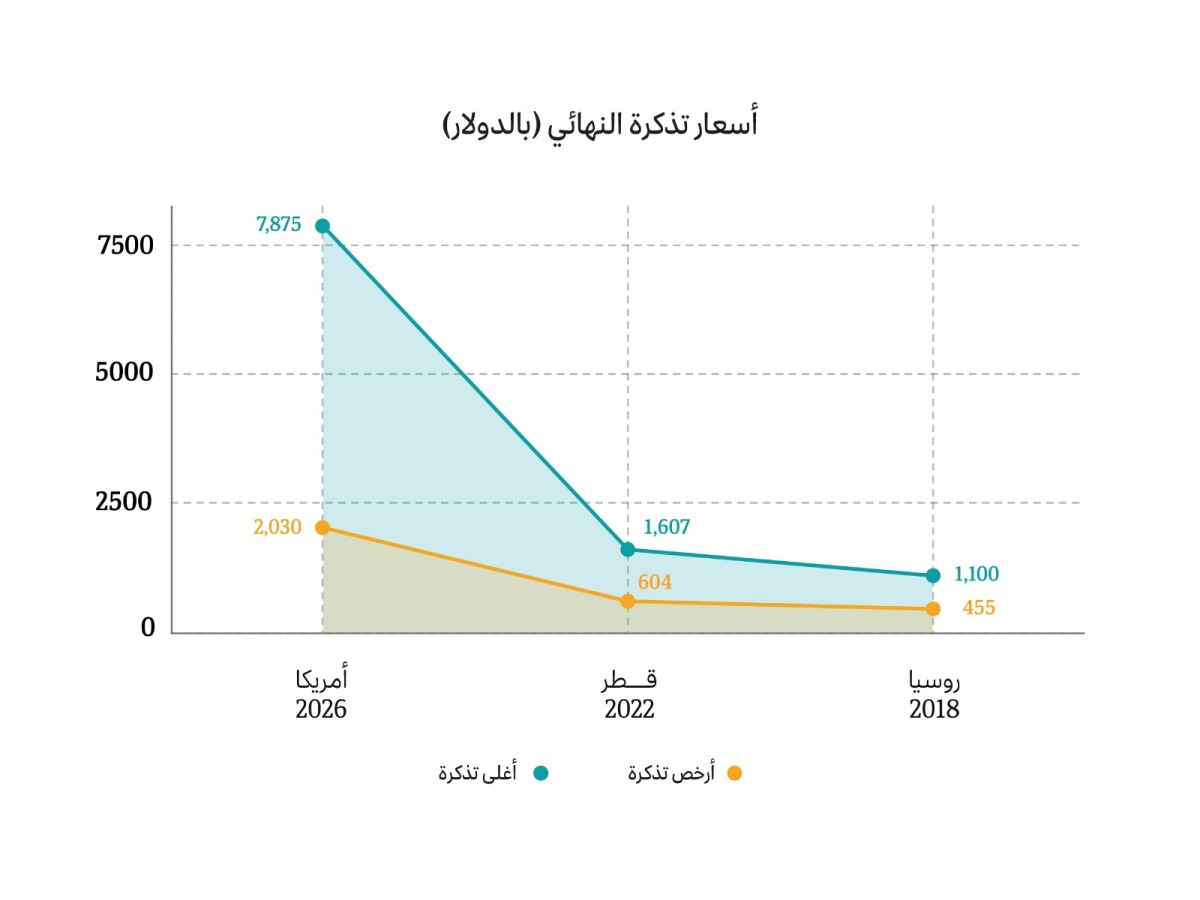
Numbers alone are enough to explain the shift. Some resale offers for tickets to the tournament final at MetLife Stadium in New Jersey reached about $11.5 million, while FIFA offered “Front Category 1” seats for the final at a price of $32,970 per ticket, in a huge jump compared to the Qatar 2022 final, where the most expensive seat was around $1,600.
As for the “parallel” market, data from the “SeatPic” ticket reservation website indicates that the average price of a ticket for the 2026 World Cup exceeded $1,600, with a much higher average for the final match.
But what is more dangerous than the numbers is the legal investigations in New York and New Jersey, official complaints before the European Commission, and mounting anger among fans who believe that football, the most famous populist game, has begun to be quietly withdrawn from their stands to be displayed in a global auction in which only those who own the price of the seat can enter.
From the field to the court…an official American investigation into FIFA
What began as a wave of public anger on social media platforms turned into a legal case par excellence, as the 2026 World Cup ticket crisis was no longer just public anger on social media sites. The file officially reached the public prosecutor’s offices in New York and New Jersey, through subpoenas issued by FIFA – the Attorneys General of New York and New Jersey, Letitia James, and Jennifer Davenport – at the end of last May to investigate FIFA’s practices related to ticket sales.
The investigation included pricing mechanisms, the method of distributing tickets to fans, and the extent to which the sales methods used contributed to inflating prices to unprecedented levels, amid accusations related to high prices, changing seat classifications, and the possibility of misleading fans.
In Washington, Congress joined the crisis line with a letter led by Representative Sidney Kamlager-Dove and signed by dozens of lawmakers calling on FIFA to reduce prices and reconsider the pricing system.
It is noteworthy that US President Donald Trump himself, who has a close relationship with FIFA President Gianni Infantino, explicitly announced in a statement to the New York Post that he would not pay a thousand dollars for a seat in the upper stands for an opening match. Here is the obvious question: If Trump himself denounces the price, how can the average fan in Africa or Asia obtain a ticket to attend the World Cup?
According to a report published by the American National Public Radio network at the end of last May, lawyer Derek Howard, a professor at the University of San Francisco, stated that there are fundamental legal questions about whether FIFA has acted in a monopolistic manner, exploiting its complete control over the sale of tickets to impose conditions that would not have been accepted in any competitive market.
Howard added that the International Federation has tightened its grip on essential information related to pricing mechanisms, the number of remaining seats, and price adjustment dates, which marketing and legal experts see as a lack of transparency and integrity.
Serious betrayal
The responses were not limited to the American interior. The Football Supporters Europe and Euroconsumers groups have filed a formal complaint with the European Commission, accusing FIFA of abusing its monopoly position and imposing unimaginable conditions in a free competitive market.
Their joint statement submitted to the Associated Press said that FIFA has absolute monopoly control over the sale of World Cup tickets, and that it uses this control to impose conditions that would not be acceptable in any real competition at all.
A number of European fan groups also described FIFA’s behavior as a “gross betrayal” of the spirit of the sport and its fans. It seems that the file has become broader than just a protest against high prices, as it touches at its core questions about the nature of FIFA’s work, the most important of which is: Is FIFA a global sports organization? Or a monopolistic commercial company seeking to maximize profits?
The answer lies with FIFA President Gianni Infantino himself when he stated that the 2026 World Cup is expected to bring the federation more than $11 billion, including broadcast rights revenues, using these numbers as justification for raising ticket prices under the pretext of harmonizing the American market.
It is no secret that FIFA charges a commission of up to 15% from every purchase and sale that takes place through the official resale platform, which makes it a direct beneficiary of the rise in prices even on the secondary market.
Data from the SeatPick platform, the largest site for collecting tickets for live events in the world, reveals that more than 500 million purchase requests were sent through the various official sales stages, with more than 75 individual matches recorded, each with ticket requests exceeding one million requests. In return for this huge demand, the average ticket price in the “parallel” market reached $1,603, while the final price on average exceeded $16,000.
What is controversial is that this model is considered a technical project within the framework of American laws related to the entertainment sector, but it reveals a wide gap between the values declared by FIFA about the “universality of football” and the pricing strategies it practices on the ground that exclude the largest part of this sport’s fans.
Unconvincing justifications
In the face of criticism, Infantino stuck to his guns when he stated: “We are simply adapting to the American market.”
FIFA officials also confirmed that the official resale platform provides a “safe and transparent” environment, and that the fees charged are consistent with prevailing standards in the North American sports and entertainment sectors.
They also pointed out the availability of tickets at prices starting from $60 for each match, including the final, distributed through the federations of the participating teams.
However, these subsidized tickets remained very limited in quantity, and major matches and national teams remained at the top in pricing.
The decision to make $60 tickets available came in the wake of a massive global public outcry, which suggests that it was a response to public pressure rather than a programmed strategic choice.
Fundamental questions remain unresolved without a satisfactory answer: Why does FIFA not impose a price ceiling on its official resale platform? How do you justify combining a 15% commission and a dynamic pricing policy at the same time?
The World Cup is only for the rich
The real dilemma is summed up in one scene if we remember four years ago, specifically at the 2022 World Cup in Qatar. The most expensive ticket for the final was about $1,100, and the cheapest was about $110. These are undoubtedly high numbers, but they were within the reach of the diligent fan who saved to attend the event of a lifetime.
Today, the lowest price for a seat in the “Met Live” final on the official resale platform reached more than $9,200 in some periods, a number that exceeds the annual income of millions of football fans around the world.
In addition, the cost of travel and accommodation in high-cost American cities, as well as the cost of transportation from Penn Station to MetLife Stadium amounted to $150, one way, for a trip that had cost only about $13, and as a result of mounting pressure, the price of the trip fell to $98.
The bottom line is that the 2026 World Cup is shaping up to be an elite event par excellence, attended by those who can pay, not those who love football, so that the event turns from a human celebration of the most popular sport in the world into a commercial exchange for investing in public passion.
Potential legal crises
The announced legal and political moves surrounding the 2026 World Cup ticket file indicate that FIFA may not close this door with the final whistle of the tournament. Subpoenas issued by public prosecutors and official letters sent by American legislators open the possibility of the crisis extending into long judicial paths, which may include lawsuits from angry fans or broader investigations into pricing and ticket sales policies.
Despite all this controversy, FIFA’s statements so far seem very confident in its ability to reap its expected record revenues, which exceed $13 billion, and this, of course, is before these cases reach decisive legal conclusions.
The deepest crisis is not in the numbers, but in the mental image that has accompanied the 2026 World Cup before its launch through the image of the FIFA system that puts profit above the audience and builds for that goal high financial walls that prevent the majority of fans of this sport from reaching its stadiums, forgetting long decades of marketing the values of unity and inclusion among millions of fans of the Magic of Nations who will be forced to follow the tournament on screens after FIFA’s prices eliminated their dreams of attending the World Cup.