

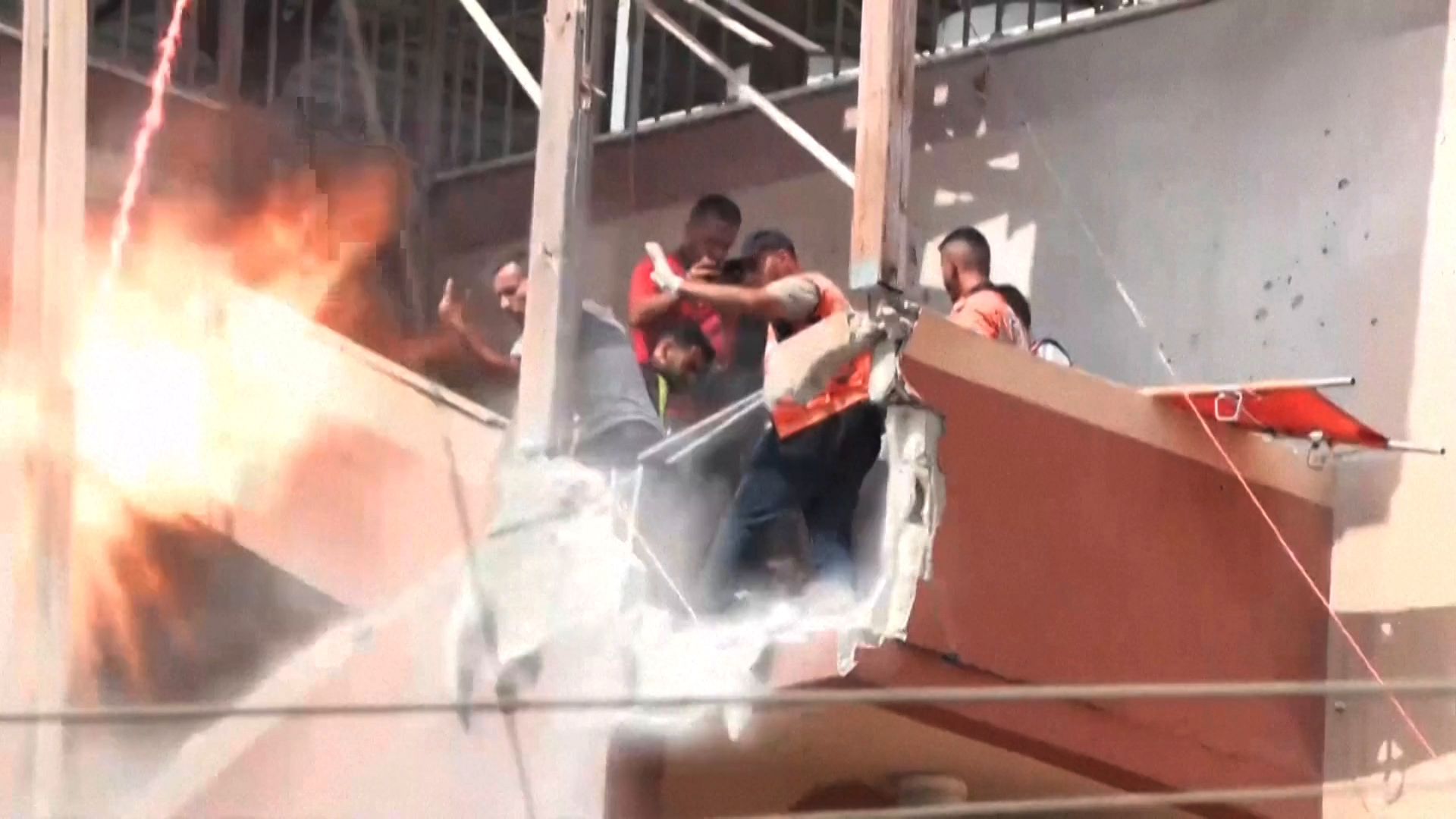
Doctors and nurses from different countries who treated Palestinians in the Gaza Strip hospitals in light of the Israeli extermination war spoke of more severe injuries than that civilians were exposed to other recent disputes, according to a study under the review of the peer.
The study, published in the British medical magazine “BMJ”, surveyed the opinions of 78 workers in the field of humanitarian health care, most of them from Europe and North America, regarding the severity of the injuries they saw while they were in the Gaza Strip, their locations and causes.
The team of British researchers stated that this is the most comprehensive data available about the Palestinian injuries during the Israeli genocide’s war, for nearly two years against the Gaza Strip, given that the medical sector facilities were destroyed and imposed severe restrictions on the arrival of international parties to it.
The chief researcher who worked on the study, the British surgeon, Omar Al -Taji, told the French Press Agency that two -thirds of the health workers worked in the past in other conflict areas, and they mostly confirmed that the injuries in the Gaza Strip were “the worst of what they saw ever.”
After a period of three months on their return from Gaza, the doctors and nurses answered based on records of records and lecturers of their shifts on survey questions about the injuries they saw during their work periods in the sector that ranged between two weeks and 12 weeks between August 2024 and February 2025.
They classified more than 23 thousand and 700 severe injuries and about 7,000 infections caused by weapons, which are very similar to the World Health Organization data, according to the study.
Uninterrupted
It is difficult to obtain data on injuries in any conflict, but the study described injuries in the Gaza Strip as “unusual in an unusual way.”
More than two -thirds of the injuries caused by weapons occurred in the sector, which is exposed to an Israeli extermination war, as a result of explosions, according to the study.
The study stated that this constitutes more than twice the rate of injuries caused by the explosions recorded among civilians in other recent conflicts.
She added that she is parallel to the rates of injuries to American soldiers during the Iraq and Afghanistan war.
In this context, Al -Taji drew attention to the presence of a “big difference” in both cases, as unlike civilians, the soldiers have training and protection and know in advance that they are facing the danger.
The study stated that “the volume of injuries, their distribution and intensity, which amount to a degree (injury), indicates patterns of harm that exceeds that record in previous recent disputes.”
Al -Taji stressed that the injured also suffered a “enormous” percentage of third and fourth degrees, which are burns that violate the skin.
When he was sent to Gaza last year, Al -Taji said that he saw “a number (shocks) of children who arrived with severe burns that their muscles and bones could be seen.”
As for the diseases that were reported most of the time, they were malnutrition and drought in the sector, as the United Nations -backed evaluation announced the famine last August.
“This is a very important work,” said Anthony Paul, a professor at the Center for Injury Studies caused by the explosions in London, Ambraal Coldge, who did not participate in the study, told the French Press Agency.
He pointed out that the data includes only the injured who “survived and managed to reach a health care worker.”
The worst
The study also included a section that allows health care workers to write freely for their observations.
One of the doctors was quoted as saying that “the worst was the mothers to save their dead children,” he said.
Others talked about the children’s expression of their “committed suicide” after they saw their families dying.
Many also talked about having to perform surgeries in very difficult circumstances in the absence of equipment or support, a situation that has led to decisions on how to legalize care in order to save patients whose chances are great.
Al -Taji arrived at the European Hospital in Gaza in May last year a few days before Israel launched its great invasion in the neighboring city of Rafah.
He said that over several nights continuously, groups of 70 people with serious injuries arrived at the hospital.
One night, Al -Taji and other doctors and nurses donated to compensate for the deficiency in supplies.
The continuous Israeli genocide war resulted in the martyrdom of more than 65,500 people, most of them civilians, according to figures from the Ministry of Health in the Gaza Strip, which the United Nations considers reliable.
More than 167,000 people were injured in the Gaza Strip, according to the Ministry of Health.
Al -Taji denounced the prevention of health workers from all over the world from entering the Gaza Strip.
Last August, the representative of the World Health Organization in the Palestinian territories, Rick Biberkorn, warned that “this arbitrary prevention” for the entry of health care workers leads to more deaths that can be avoided.