

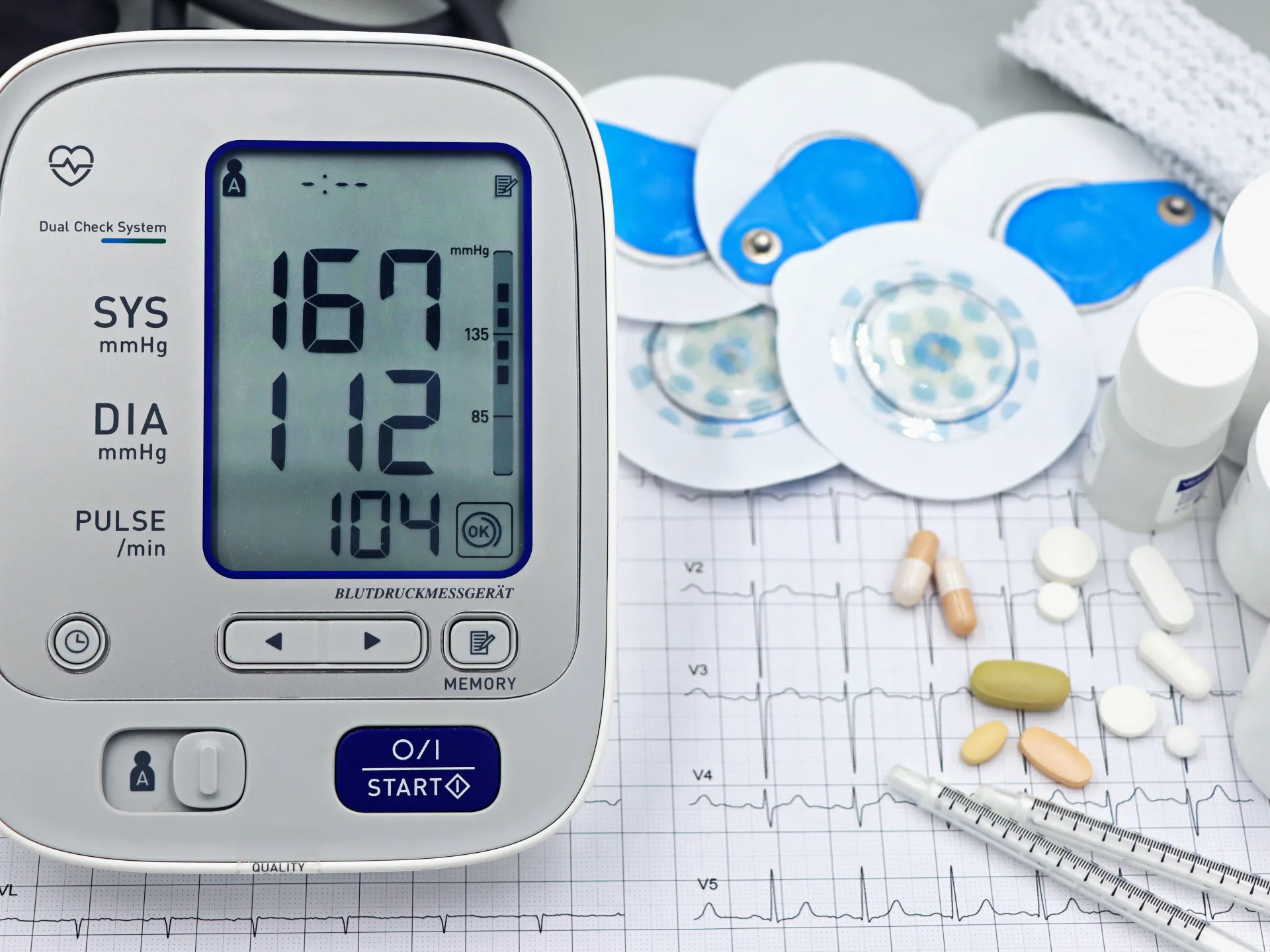
A high blood pressure reading may cause concern, especially for someone who has not previously been diagnosed with high blood pressure. But the number that appears on the device at a certain moment does not necessarily reflect the usual blood pressure, as the pressure changes during the day, and it may also be affected by stress, exertion, caffeine, pain, lack of sleep, and the method of performing the measurement.
Therefore, the diagnosis of high blood pressure does not usually depend on a single transient reading, but rather on repeated measurements taken correctly, so that it is possible to distinguish between temporary high blood pressure and persistent high blood pressure.
Why does the pressure reading change?
Family medicine consultant Dr. Fatima Al-Zahraa Nour El-Din says that high blood pressure is not usually diagnosed from a single reading, because blood pressure can change from time to time due to stress, exertion, coffee and certain foods, lack of sleep, or pain.
The European Society of Cardiology guidelines for the year 2024 confirm that measuring blood pressure in one visit is usually not enough to confirm the diagnosis, especially when the reading is close to the diagnostic limits, and it is preferable to confirm it with measurements outside the clinic, or by repeating the measurement in a subsequent visit if this is not possible.
The guidelines define office high blood pressure as 140/90 mmHg or higher, while the average home blood pressure limit is 135/85 or higher, and the 24-hour ambulatory average is 130/80 or higher.
Errors that change the measurement result
Dr. Fatima Al-Zahraa explained that when measuring blood pressure at home, one should avoid measuring after exercising, drinking coffee, or smoking, and sit quietly for 5 minutes before the measurement, and not speak or move during the measurement, while placing the back and arm in the correct position and using a cuff suitable for the size of the arm.
The American Heart Association recommends not smoking, drinking beverages containing caffeine, or exercising 30 minutes before the measurement, emptying the bladder and sitting quietly for 5 minutes. The back should be supported, the feet should be on the floor, the arm should be supported at the level of the heart, and the cuff should be placed directly on the skin, with the use of a reliable device and a cuff that fits the size of the arm.
Simple errors during measurement, such as speaking, not supporting the arm, or using an inappropriate cuff, may affect the result and make it less representative of the true blood pressure.
When do we repeat the measurement?
Dr. Fatima added that it is preferable to take two readings, one or two minutes apart, and record the readings. The pressure can be measured in the morning and evening for several days to obtain a more accurate average.
This is consistent with European guidelines, which recommend when measuring at home, taking two readings in each session, one to two minutes apart, and measuring in the morning and evening for a period of no less than 3 days and may extend to 7 days, then calculating the average of the readings.
The importance of confirming the diagnosis is supported by a systematic review published by JAMA in 2021, which included 52 studies that included more than 215,000 people. It was found that in-clinic blood pressure measurements alone suffer from limitations in accuracy that may lead to misclassification of some people, which supports the importance of using home measurement or mobile monitoring to confirm the diagnosis.

White coat and masked pressure
Dr. Fatima referred to what is called “white coat hypertension,” in which the pressure is high in the doctor’s office but is normal at home, and therefore the doctor may ask to measure the pressure at home or using a device for 24 hours.
On the other hand, there is an opposite condition known as “Masked Hypertension”, in which the pressure is below the threshold for diagnosing high blood pressure in the clinic, but exceeds the threshold when measured at home or with ambulatory monitoring. Measurements outside the clinic help detect both conditions and create a more accurate picture of normal blood pressure.
When should you see a doctor?
Dr. Fatima stressed that a doctor should be consulted if the readings are repeatedly high, or if symptoms appear such as severe headaches, dizziness, blurred eyes, chest pain or shortness of breath, although these are not necessarily symptoms of high blood pressure, but if they appear with high readings, they require medical evaluation.
The absence of symptoms does not mean that blood pressure is normal, as high blood pressure does not cause clear signs or symptoms in most people, so the main way to detect it is to measure the pressure.
Dr. Fatima added that if the blood pressure reading is 180/120 or more, especially with chest pain, shortness of breath, or sudden weakness, urgent medical assistance must be sought.
The American Heart Association recommends that when a reading is higher than 180/120 mmHg, wait at least one minute and then repeat the measurement.
If the reading continues at this level and is accompanied by chest pain, shortness of breath, numbness, weakness, change in vision, or difficulty speaking, this is a medical emergency. As for the continued increase without new and worrying symptoms, prompt communication with a health care provider is required.
Thus, a single high reading does not automatically mean high blood pressure, but repeated high blood pressure requires recording the readings correctly and seeing a doctor to determine whether the matter is transient or requires follow-up or treatment.