

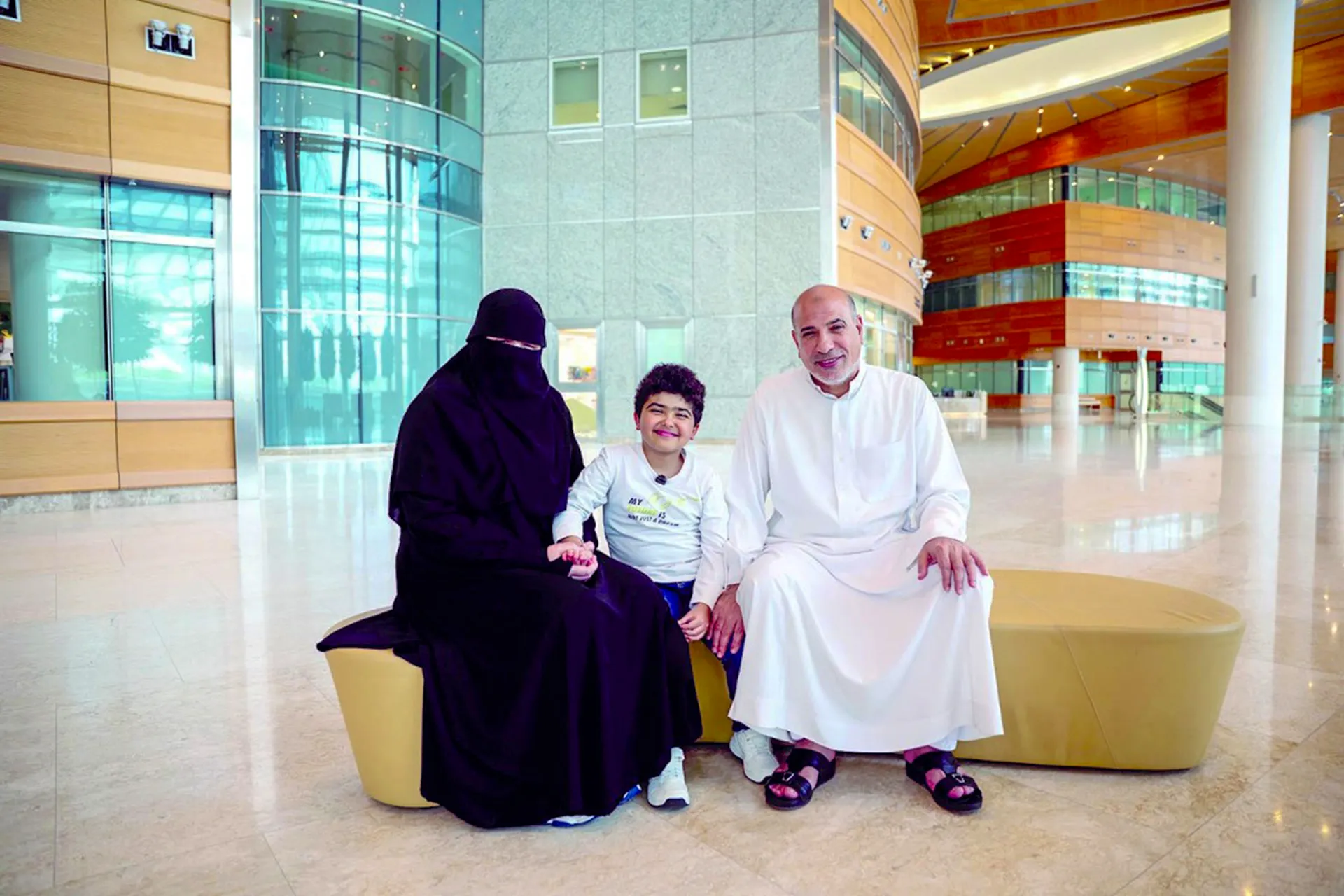
In a development that reflects the great acceleration in the field of gene therapies, Sidra Medicine Hospital, affiliated with Qatar Foundation, announced its success in treating an Egyptian child with Duchenne muscular dystrophy using modern gene therapy.
This is the tenth case to receive this type of treatment since it began to be applied in the hospital about two years ago, in a medical achievement that enhances patients’ hopes and opens new horizons for treating rare genetic diseases.
The 10-year-old Egyptian child, Ali Al-Habashi, came to Doha with his parents last December, after a long journey of searching for a treatment that suits his condition, which was diagnosed at the age of three with Duchenne muscular dystrophy, which remained for years without effective treatment options until the recent announcement of gene therapy about two years ago.
Ali was born in Menoufia Governorate, north of Cairo, naturally, without any disturbing signs appearing in his first months. But as he began trying to walk and move, his family noticed obvious difficulty in his steps, in addition to his frequent falls, which raised their fears and prompted them to see doctors and undergo the necessary tests.
Since that time, a long and difficult journey began to reach an accurate diagnosis, which is Duchenne muscular dystrophy, as the child began the treatment journey according to the available protocols, which included cortisone, physical therapy, vitamins, and traditional non-genetic medications, in an attempt to keep his condition from deteriorating as much as possible.
But the real hope began when the new gene therapy available at Sidra Medicine was announced, so the parents took the initiative to contact the hospital, which provided great support to them and helped them facilitate all procedures, until the child, accompanied by his parents, arrived in Doha to receive treatment.
After a series of advanced clinical evaluations at Sidra Medicine in Doha, the child’s eligibility to receive treatment was determined, and he received the therapeutic dose on the first of last March under the supervision of a specialized medical team.
What is Duchenne muscular dystrophy?
Tawfiq Bin Omran, head of the Department of Genetics and Genomic Medicine at Sidra Medicine, says that Duchenne muscular dystrophy is one of the most common types of muscular dystrophy globally, and it primarily affects males at a rate of approximately one case for every 3,500 male births.
He pointed out in a statement to Al Jazeera Net that the symptoms of the disease begin to appear with the child’s movement, especially when he starts walking, as he faces obvious difficulty as a result of the disease’s effect on the muscles.
Although pregnancy and childbirth are often normal, signs such as delayed walking, tiptoeing, or frequent falls are early indicators that require attention and medical evaluation.

Bin Omran, who is the head of the medical team supervising the application of this treatment, pointed out that there are some medical indicators that may appear during routine examinations, such as elevated liver enzymes, which may sometimes be an indication of a problem in the muscles and not in the liver, and the symptoms may not be clear at first, and in some cases there may also be a percentage of mental delay, although not significant.
However, there is an important sign that parents may notice, which is that the child suffers from muscle weakness or that the lower leg muscles are enlarged. This enlargement is not an indication of strength, but rather occurs as a result of the replacement of muscle tissue with fatty tissue and fibers, which may cause confusion among families.
Motor symptoms
The problem appears with the onset of motor symptoms, since the disease primarily affects the motor muscles. As the disease progresses, especially in the absence of treatment, the child gradually loses his ability to walk, becomes paralyzed and relies on a wheelchair, usually between the ages of 10 and 12 years.
Bin Omran added that after the age of 12 years, other muscles begin to be affected, such as the breathing muscles. At the age of 18 to 20 years, a patient may need breathing aids. The heart muscle is also affected as the disease progresses, and this may lead to heart failure, explaining that respiratory or heart failure is one of the main causes of premature death in these cases.
Gene therapy
Regarding treatment, Bin Omran explains that until 2023, the only internationally approved treatment was cortisone, which is neither a gene therapy nor a cure, but rather works to reduce inflammation in the muscles, contributes to slowing the deterioration of the patient’s condition and delays the loss of the ability to walk for several years.
In 2023, a gene therapy called “Elevidis” was developed, which achieves its effectiveness by introducing the functional “dystrophin” gene directly into muscle cells, which negatively slows the pace of disease progression and enhances muscle functions.
Sidra Medicine is one of the leading hospitals in applying this treatment at the regional level, as gene therapy has been given so far to 10 children, with preparations to treat two additional cases, bringing the total number to 12 children by the end of this April. The ages of the children who received the treatment range between 4 and 11 years old.
The primary goal of gene therapy in cases of Duchenne muscular dystrophy is to stop the deterioration of the patient’s health condition instead of worsening his symptoms over time, which leads to serious effects on the respiratory muscles and heart, and may lead to a complete loss of the ability to move.
Cost of treatment
For his part, the medical director of Sidra Medicine, Professor Ibrahim Al-Janahi, confirmed in a statement to Al Jazeera Net that after about two years of applying this type of treatment, the results showed a noticeable improvement in the cases that underwent it, as the disease stopped deteriorating, and with an actual improvement in motor abilities, which represents an important medical achievement in dealing with this type of difficult diseases.
Regarding the cost of treatment, Al-Janahi explained that gene therapies are among the most expensive in the world, noting that the cost of treating Duchenne muscular dystrophy amounts to $3 million, and that the treatment is given only once in a lifetime, and is administered intravenously, in the form of a dose that takes about one hour. The patient is then subjected to continuous weekly follow-up at the gene therapy clinic, continuous examinations are performed, and physical and occupational therapy sessions are provided.

This treatment is still available in a limited number of countries around the world, as it has not yet been registered in many countries such as most European countries and Australia, while it is available in the United States and some other countries, including a number of Gulf countries such as Qatar, the Emirates and Kuwait.
Sidra Medicine receives cases from inside and outside Qatar through the international office, which undertakes full coordination with international patients, whether in terms of medical procedures or administrative and financial arrangements, and is provided to Qatari citizens free of charge, while some cases from residents or those coming from abroad are supported through charitable bodies or humanitarian initiatives.