

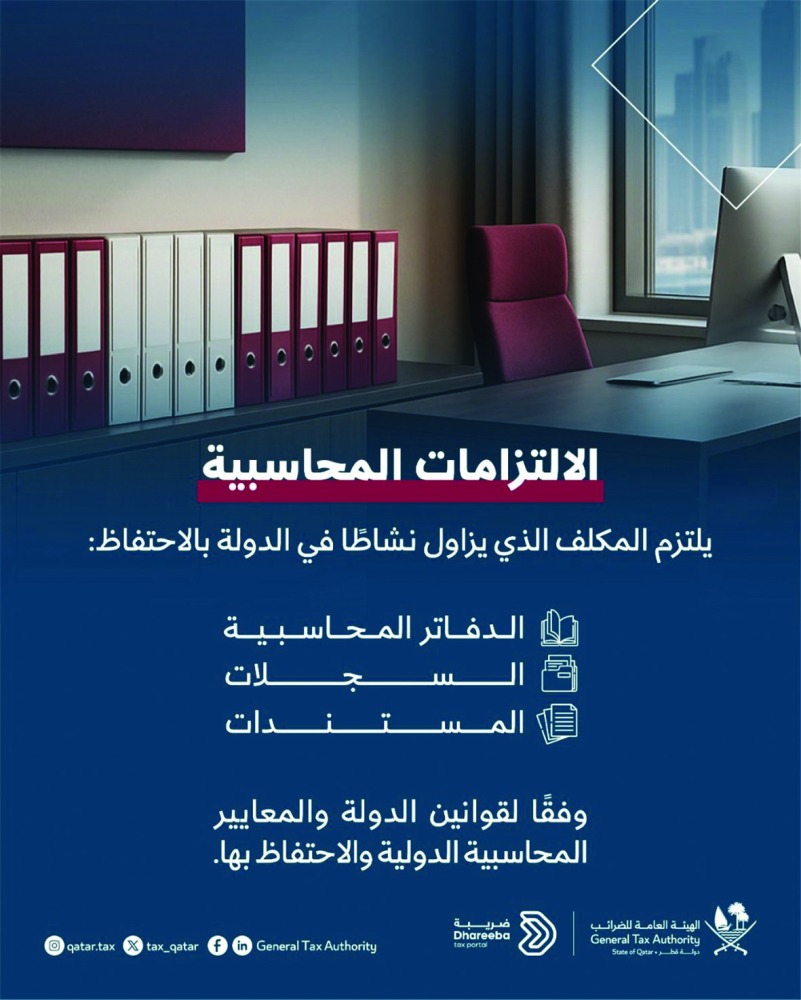
The General Authority for Taxes has required companies in the country to maintain their accounting books and records in accordance with international standards for a period of 10 years, unless the General Authority for Taxes issues an exception, within the framework of enhancing transparency and consolidating the principles of governance. This came in advice announced by the Tax Authority on its official account on the social networking site X.
The taxpayer who carries out an activity in the state is obligated to maintain accounting books and records and the documents related to them and the documents proving them necessary for his activity in accordance with the laws and accounting standards in force in the state, in particular the following: the general journal. And the general ledger. And the inventory book.
Taxes said that the taxpayer who carries out an activity in the state must keep the accounting books and records related to the income tax for a period of 10 years following the year to which those books, records and documents relate, unless a dispute is related to them before any party, in which case he must keep them as long as the dispute exists.
Income tax
The tax is imposed on the total taxable income arising in the country, generated by every natural or legal person who carries out an activity or achieves taxable income.
The tax due is collected according to the following: The tax is paid based on the declaration submitted by the taxpayer. As for the tax due pursuant to a tax assessment decision issued by the General Tax Authority, the tax must be collected within thirty days from the expiry of the period for objection to the assessment decisions without submitting an objection. In the event that an objection is submitted by the taxpayer, the tax due is paid within thirty days from the date of expiry of the taxpayer’s notification of the Authority’s response to the objection.
The tax is also paid electronically via the “Taxa” platform.
Income subject to income tax
Income generated in the country includes, for example, the following: Gross income arising from an activity carried out in the State of Qatar. Gross income arising from contracts implemented wholly or partially in the State of Qatar. The gross income arising from real estate located in the country, and the capital gains arising from its disposal. The gross income arising from shares or shares of companies residing in the country or listed in its financial markets, and capital gains arising from their disposal. In exchange for services paid to centers, main headquarters, branches, or to associated companies… the gross income resulting from exploration, extraction, or exploitation of natural resources located in the country. The gross income that is subject to tax in the country based on a tax agreement.
The tax is imposed according to the following:
10% of taxable income for all activities not subject to another rate.
35% of taxable income is applied to activities related to the petrochemical industries as well as to petroleum operations. This percentage may increase according to some agreements.
5% final deduction at source on amounts paid in accordance with the law.
Tax exemptions
All of the following are exempt from tax:
-Qatari citizens residing in the country
-Companies residing in the country and wholly owned by Qatari citizens
Profits of Qatari citizens in non-Qatari companies residing in the country
– Agricultural and fishing activities in the country
-Non-Qatari air or maritime navigation companies in the country on the condition of reciprocity.
Tax portal:
“Tax” is an electronic system that links the General Tax Authority and its partners from the relevant government agencies, and taxpayers (taxpayers), and manages, calculates and reviews the various types of taxes. It also helps taxpayers know the procedures for their transactions, in accordance with the tax laws in Qatar.
The electronic tax portal aims to provide the best tax services and make them available in an effective and easy manner. It manages, calculates and reviews different types of taxes. It also helps taxpayers know the procedures for their transactions electronically, which contributes to achieving better results in general for the state. It also saves taxpayers time and effort to benefit from the Authority’s services, the most important of which are: issuing the tax card and appointing the taxpayer’s representative.
The system provides integrated and easy services that provide the opportunity for companies to verify the accuracy of tax returns and all required documents and documents, and facilitate the process of paying taxes through an approved electronic portal.
In addition, companies receive immediate notifications and alerts regarding their transactions, with the aim of reducing expected errors when submitting new applications. It also saves time and effort in the event of the need to submit documents or documents required to complete previous transactions.