

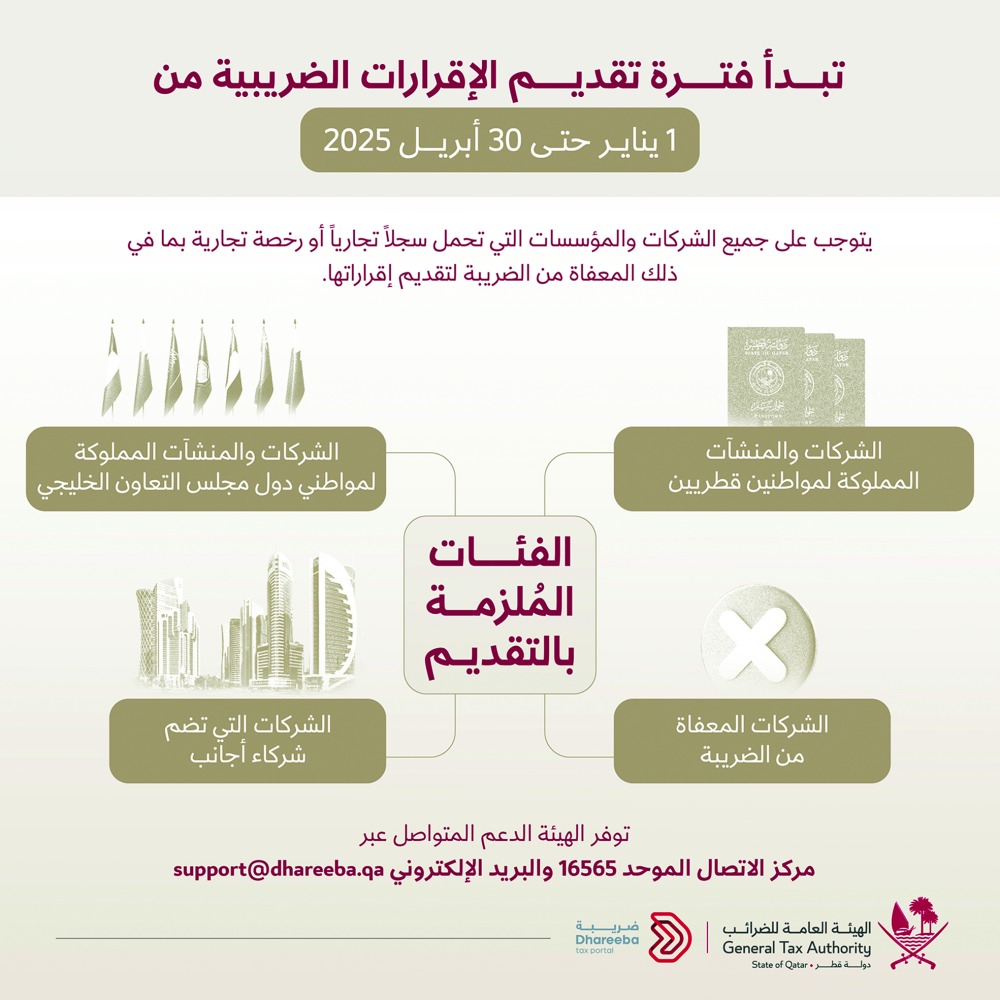
The General Tax Authority announced the start of the period for submitting tax returns for the tax year ending on December 31, 2024, starting from the first day of January 2025 until no later than next April 30.
This step comes in implementation of the provisions of the Income Tax Law (Law No. 24 of 2018 and its executive regulations and their amendments), whereby all entities subject to the provisions of this law, including companies exempt from tax, owned by Qatari citizens or citizens of Gulf Cooperation Council countries, and companies must: Which includes foreign partners, the obligation to submit tax returns within the specified time period.
The Authority called on all companies and institutions that hold a commercial register or commercial license – including those exempt from tax – to submit their returns through the electronic “tax” portal.
In this context, the Authority explained that it is constantly working to provide an integrated system that ensures facilitating the process of submitting tax returns, and providing the necessary support to taxpayers to fulfill their tax obligations on the scheduled dates, indicating that the Authority will continue to provide all forms of support and assistance to taxpayers, whether through the call center (16565). ) or email ([email protected]) for tax matters.
This approach comes within the framework of the Authority’s keenness to facilitate tax procedures and enhance compliance, which contributes to achieving the objectives of the state’s financial policy and supporting economic growth.
Tax returns are submitted through the electronic tax portal and can also be submitted through the tax application (the service has been activated for companies that meet the conditions for submitting the simplified return).
The instructions provided by the Tax Authority included complete explanations of the tax returns, those responsible for submitting them, the facilities provided by the Authority, and the tax system of the electronic platform through which the submission is made.
Companies obligated to appoint an audit office
The General Tax Authority revealed during its instructions that there are two types of companies obligated to submit tax returns. The first is companies obligated to appoint an auditing-accounting office – which are companies with 100% foreign ownership, or companies that include Qatari and foreign partners, if the capital exceeds 200 thousand. riyals, or the total revenues exceed 500 thousand riyals, or the main headquarters is outside the country.
Likewise, companies that are 100% owned by Qataris or citizens of the Gulf Cooperation Council countries, and whose capital is 1 million riyals or more, or whose revenues during the year are 5 million riyals or more.
It is also committed to appointing an audit office for companies owned 100% by citizens of the Gulf Cooperation Council countries without proof of residency in the State of Qatar.
Companies that are not obligated to appoint an audit office
The Authority explained that the second type is companies that are not obligated to appoint an audit-accounting office and can submit a simplified tax return.
These are companies owned 100% by Qataris or citizens of the Gulf Cooperation Council countries, provided that residence in the State of Qatar is proven, and that their capital is less than 1 million riyals and their revenues during the year are less than 5 million riyals.
As for home projects that have a home license and do not have a commercial register, they are not obligated to appoint an audit office.
The Tax Authority confirmed that the simplified tax return can be submitted independently without the need to appoint an audit office, through the electronic tax portal or the tax application.
Conditions for submitting a simplified tax return
Regarding the conditions for submitting simplified tax returns, the Authority confirmed that they include: residence in the State of Qatar, capital being less than 1 million riyals, and total revenues being less than 5 million riyals for companies owned by Qatari citizens or from Gulf Cooperation Council countries.
Those charged with submitting declarations
All companies that have a commercial register, even if they do not carry out commercial activity, as well as individuals who engage in economic activities and generate taxable income, are obligated to submit a tax return, even if they benefit from a tax exemption such as Qatari citizens.
Companies obligated to pay
Income tax
Regarding the categories subject to and obligated to pay income tax, the Authority confirmed that they include companies with 100% foreign ownership, and companies that include Qatari and foreign partners.
Companies exempt from payment
Income tax
As for the companies exempted from income tax, they are companies owned 100% by Qataris and citizens of the Gulf Cooperation Council countries, and residence in the State of Qatar must be proven.
Regarding the documents required to submit tax returns, the Authority explained that for income tax (simplified return), the documents are those related to the items of the simplified return (revenues, rents, salaries, public expenses).
As for the income tax (entitlement principle), the documents are:
Financial statements prepared in accordance with the accounting standards applicable in the country
Home projects
Owners of licensed home projects must register with the tax office, which are projects in which the owners base their homes and carry out their activities. The Ministry of Trade and Industry has granted them licenses to conduct business in homes.
These are projects that consist of activities that do not require high costs, rely mainly on personal skills, do not use equipment that disturbs comfort or dangerous materials, and their goal is to obtain a degree of profit and save living costs for the licensee and his family.
To facilitate the owners of these projects, a ministerial decision was issued stipulating the abolition of the requirement to place an identification sign at the entrance to the house licensed to practice the activity, while not placing any advertising or promotional signs on the house or its external walls, and placing flags or ribbon signs is prohibited.
This amendment came as an incentive for small business owners, and to facilitate license applicants to conduct business in homes, as placing the identification plate may expose the residents of the house licensed to practice the activity in it or part of it to embarrassment, and be a reason for not requesting a license, and given the privacy considerations of the Qatari society, And to maintain the continuity of home projects.
Granting licenses to practice businesses at home aims to regulate the practice of commercial activities from home, and to open opportunities for entrepreneurs and small project owners and to encourage them to be creative, develop and support their abilities and ideas, to invest in their own projects, by allowing them to practice some commercial activities from their homes, which makes It constitutes an incentive to expand and develop their projects, open commercial stores, and contribute to economic development and economic diversification.
Tax portal
“Tax” is an electronic system that links the General Tax Authority and its partners from the relevant government agencies, and taxpayers (taxpayers), and manages, calculates and reviews the various types of taxes. It also helps taxpayers know the procedures for their transactions, in accordance with the tax laws in Qatar.
The electronic tax portal aims to provide the best tax services and make them available in an effective and easy manner. It manages, calculates and reviews different types of taxes. It also helps taxpayers know the procedures for their transactions electronically, which contributes to achieving better results in general for the state. It also saves taxpayers time and effort to benefit from The Authority’s services, the most important of which are: issuing the tax card and appointing the taxpayer’s representative.
The system provides integrated and easy services that provide the opportunity for companies to verify the accuracy of tax returns and all required documents and documents, and facilitate the process of paying taxes through an approved electronic portal.
In addition, companies receive immediate notifications and alerts regarding their transactions, with the aim of reducing expected errors when submitting new applications. It also saves time and effort in the event of the need to submit documents or documents required to complete previous transactions.