

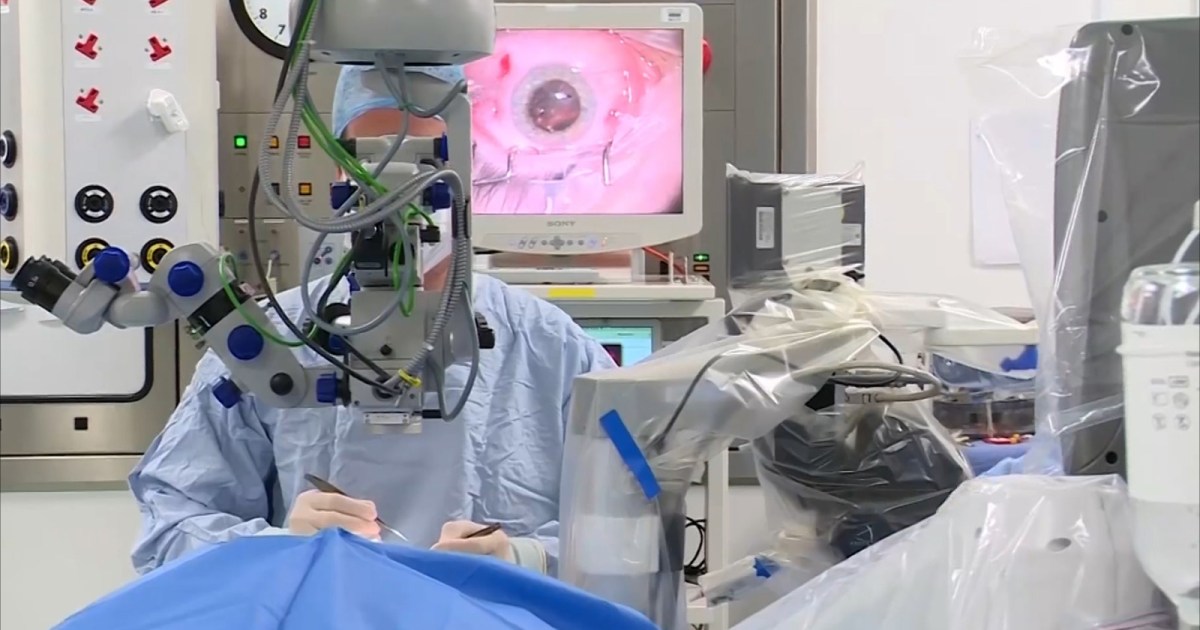
Researchers have discovered that the nanoparticles – which are very small molecules of gold, are thinner thousand times than human hair – can help restore vision in people with retinal retinal diseases.
The study was conducted by researchers from the University of Brown in the US state of Rhod Island, and its results were published in the “ACS Nano” magazine, and wrote about the “Yorik Alrt” website.
This technique was tested on mice, and the results of the study showed that the injection of nanoparticles in the retina can stimulate the optical system and restore vision of mice infected with retina. This technique may pave the way for the development of medical glasses that help patients to restore vision.
The retinal disorders, most notably the “Macular Degeneration”, is one of the main causes of the loss of vision in the elderly, and affects millions of people around the world, making finding new therapeutic solutions that have an urgent necessity. Although treatments are available to slow up the development of age -related macular degeneration, they are not totally treated.
Network disorders cause harm to light -sensitive cells in the retina, which makes it difficult for the brain to treat visual signals.
New innovation
The new innovation includes injecting the nanoparticles directly into the retina, to overcome damaged cells and stimulate healthy cells using sub -red lasers, and in a similar way to the way optical receptors operate.
Experiments on mice showed that this motivation succeeded in restoring part of the vision without any negative side effects, which is a positive step in the treatment journey.
Researchers perceive that a system that combines nanoparticles with a laser -fixed laser system is merged with a camera to take pictures from the outside world. This data will be used to direct the laser beam to the retina, stimulate the golden molecules and stimulate the visual system, enabling patients to restore vision.
This method is safer and less surgical intervention than ancient systems that required planting electrical poles in the eye. Also, this method can completely cover the field of vision, unlike the previous methods that were limited to a narrow vision.