

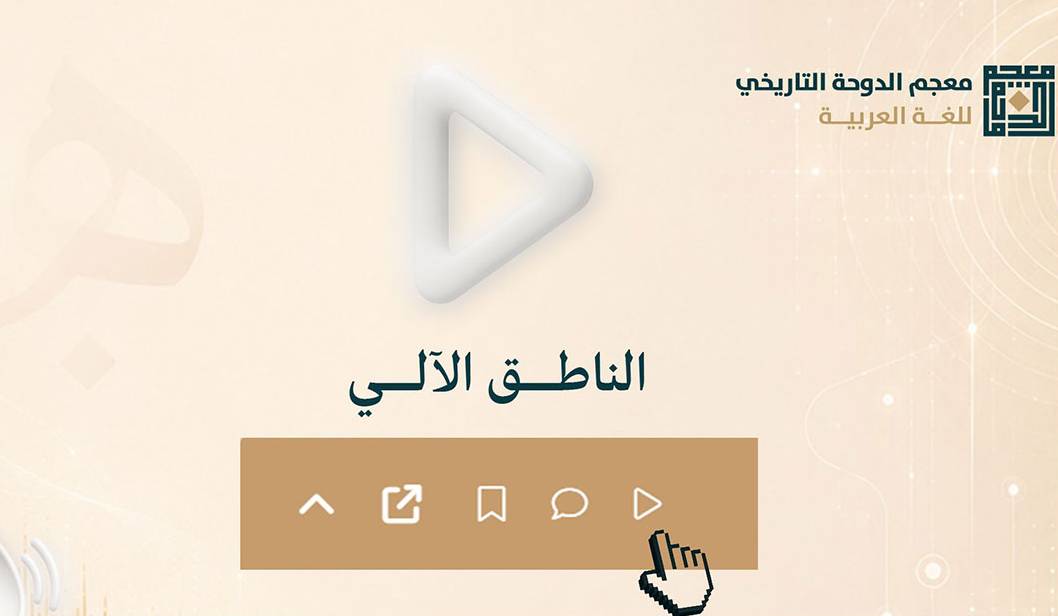
The Doha Historical Dictionary of the Arabic Language launched the “automated speaker” service on its electronic portal, with the aim of enhancing users’ experience and facilitating access to and benefiting from dictionary content in multiple media.
The Doha Dictionary stated, in a statement today, that this service allows listening to lexical entries, their definitions, and historical evidence contained in the dictionary, including prose texts, poetic verses, and holy Qur’anic verses, which provides users with an additional means of interacting with and exploring the content, and enhances its availability to a wider segment of researchers, scholars, and those interested in the Arabic language, as well as its learners who are non-native speakers.
In this context, Dr. Muhammad Al-Obaidi, Executive Director of the Doha Historical Dictionary of the Arabic Language, said: “The launch of the automated speaker service comes in the context of developing the electronic portal services for the Doha Historical Dictionary of the Arabic Language, with the aim of enabling users to verify the correct reading of dictionary entries, their definitions, and their historical evidence.”
Al-Obaidi explained that the automated speaker service will contribute to expanding the circle of benefit from dictionary content, especially among users who prefer audio content, or need to listen to texts while browsing and studying, thus enhancing the presence of Arabic in the digital environment and increasing the ease of accessing and benefiting from lexical content.
He pointed out that the user can activate the “automated speaker” service directly from the lexical portal page by clicking on the designated playback icon, and listening to the lexical material in a clear automatic voice that takes into account the integrity and quality of pronunciation.
In addition, the Doha Historical Dictionary of the Arabic Language affirmed its commitment to continuing to develop its electronic portal, by employing the latest digital technologies and launching more qualitative services that enhance access to lexical content and facilitate interaction with it, thus consolidating the dictionary’s position as a renewed knowledge project that keeps pace with rapid technical transformations.